
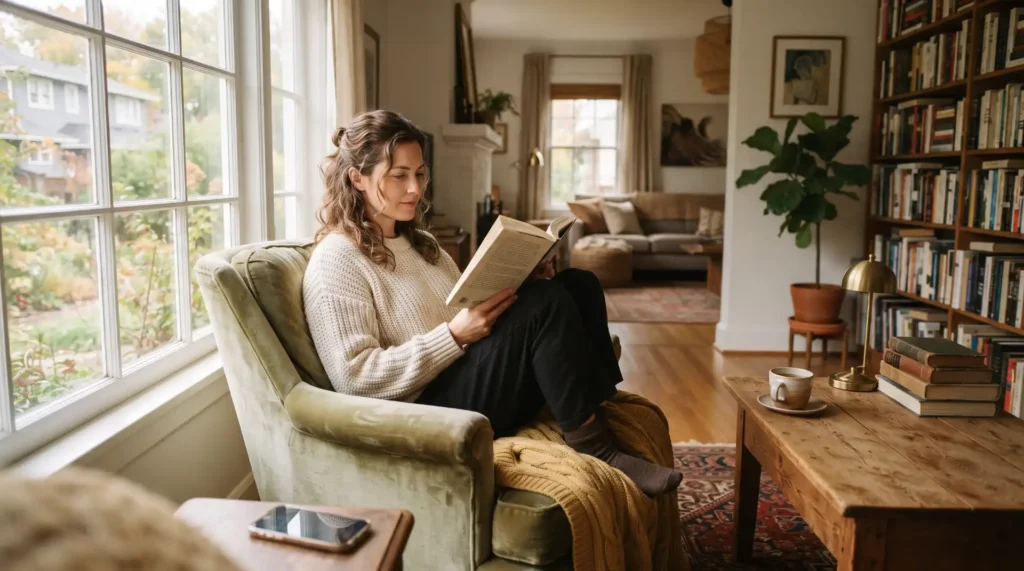
For years, reading culture online seemed increasingly focused on numbers.
Readers posted annual totals. Apps counted completed titles. Social media challenges encouraged people to finish dozens, sometimes hundreds, of books each year. Short books became attractive partly because they helped readers move quickly toward another completed title.
Now another philosophy is gaining attention.
Slow reading encourages people to stop treating books like items on a productivity checklist. Instead of asking how many books they can finish, readers focus on how deeply they can experience the books they choose.
That might mean spending a month with an 800-page novel. It could mean rereading a difficult chapter instead of rushing ahead. Some readers are putting their phones away, choosing physical books, annotating passages, or deliberately reading fewer titles during the year.
The trend arrives at an interesting moment in American reading culture. A 2026 Pew Research Center report found that 75% of U.S. adults had read at least part of a book during the previous 12 months. Print remained the most common format, with 64% reporting that they had read a printed book.
Slow reading does not reject e-books, audiobooks, or technology. Nor does it suggest that long books are automatically better.
Instead, it challenges one simple idea: that reading more titles always means having a better reading life.
For many readers, quality is beginning to matter more than quantity.
What Does Slow Reading Actually Mean?
Slow reading is less about literal reading speed and more about intention.
A slow reader does not necessarily move through every sentence at a reduced pace. Someone might naturally read fairly quickly while still practicing slow reading.
The difference is that the reader is not rushing primarily to finish.
Slow reading means giving a book enough time to unfold.
Readers might stop to think about an idea, reread a powerful paragraph, look up historical context, annotate a page, or simply sit with a chapter before continuing.
It can also mean choosing books without worrying about their length.
A 700-page historical novel becomes less intimidating when the goal is no longer to finish twelve books this month.
The philosophy resembles other “slow” movements that have appeared in modern culture.
Slow food values the process of preparing and enjoying meals rather than treating eating purely as convenience.
Slow travel encourages visitors to experience one place deeply instead of trying to photograph ten attractions in one afternoon.
Slow reading applies the same idea to books.
Instead of asking, “How quickly can I finish this?”
The reader asks, “What can I get from spending time with this?”
Why Reading Started Feeling Like a Competition
Reading has always had measurable elements.
Libraries track books borrowed. Schools assign reading lists. Children receive prizes for completing books. Adults proudly count the titles they finish every year.
Digital reading platforms made those numbers much more visible.
Today, readers can track pages, percentages, reading streaks, annual totals, ratings, and challenges. Social platforms make those statistics easy to compare with everyone else’s.
That can be motivating.
A reading goal can encourage someone to pick up a book instead of opening another streaming app. Tracking progress can provide a satisfying sense of accomplishment.
Problems appear when the number becomes more important than the experience.
Readers sometimes begin choosing shorter books because they can finish more titles.
Others avoid rereading favorite novels because rereading does not expand their list of completed books.
Some abandon demanding books they would otherwise enjoy because those titles take too long.
Community discussions reveal that this pressure is real for at least some readers. In one late-2025 BookTok discussion, a reader described feeling behind after seeing people announce totals of 50 or more than 100 books per year, despite personally finishing about 20. Another participant said reading had started to feel “like a race instead of a refuge.”
Slow reading responds to that mentality.
It gives readers permission to stop racing.
Longer Books Fit Naturally Into Slow Reading
Long books are not new, of course.
Some of the most enduring works in fiction are enormous. Epic fantasy, historical fiction, literary novels, biographies, and multigenerational sagas regularly stretch past 500 pages.
Yet long books can feel difficult in a culture shaped by constant measurement.
Suppose one reader finishes four 200-page novels while another spends the same amount of time reading one 800-page novel.
A reading tracker might make the first person appear more productive.
In reality, both readers have read approximately the same number of pages.
The difference exists mainly because books are counted as units.
Slow reading removes some of that psychological pressure.
When readers stop worrying about annual totals, book length becomes less important.
A thick novel stops looking like an obstacle between the reader and their reading goal.
It becomes the reading experience itself.
This can open the door to books that readers previously postponed because they seemed too demanding.

Digital Distraction Is Helping Create a Countermovement
One reason slow reading resonates today is that modern life rarely feels slow.
Americans move between smartphones, social media, streaming services, emails, messaging apps, podcasts, news alerts, work platforms, and endless notifications.
Even leisure can become fragmented.
A person might watch television while checking a phone, scrolling through social media, responding to messages, and looking up information simultaneously.
Books demand something different.
Traditional reading asks the reader to remain with one stream of information for an extended period.
That can feel unusually demanding when daily life trains attention to jump constantly between screens.
It can also feel refreshing.
Slow reading turns that difference into the point.
A reader might deliberately leave a phone in another room and spend an hour with one chapter.
The objective is not speed.
It is sustained attention.
For some readers, this makes a physical book particularly appealing. There are no notifications hidden between the pages. The book cannot suddenly recommend a video or display a message.
That simplicity may help explain why print continues to occupy a strong position even after years of digital growth.
Pew Research Center reported in April 2026 that 64% of American adults had read a print book during the previous year. E-books reached 31%, while 26% had listened to an audiobook.
Those formats can coexist, but printed books offer an especially natural environment for readers seeking fewer digital interruptions.
The Return of Deep Reading
Slow reading also connects with the idea of deep reading.
Deep reading means engaging with a text beyond basic information gathering.
A reader notices patterns.
They reflect on arguments.
They make connections between characters, events, and earlier chapters.
They think about language instead of merely extracting plot.
This becomes especially valuable with books designed to reward attention.
A literary novel may reveal meaning through recurring imagery.
A history book may build an argument across hundreds of pages.
A biography may gradually show connections between early experiences and later decisions.
Reading those books purely for speed can reduce what the reader gets from them.
Longer works often require memory and patience.
Characters introduced 300 pages earlier may suddenly become important.
An apparently minor historical event may become central to an argument several chapters later.
The reader is rewarded for remembering, connecting, and reflecting.
Slow reading provides the mental space for those connections.
Reading Fewer Books Can Reduce Decision Fatigue
There is another unexpected advantage to choosing fewer books.
Readers have more options than ever.
Online bookstores contain millions of titles. Social media introduces new recommendations every day. BookTok, Bookstagram, newsletters, review sites, podcasts, and online communities continually add titles to already crowded reading lists.
Discovery can become overwhelming.
Readers may own dozens of unread books while continuing to search for new ones.
A slow reading mindset changes the relationship with the “to be read” pile.
Instead of constantly asking what comes next, readers can focus on the book they already chose.
That reduces decision fatigue.
There is no requirement to keep up with every viral release.
A reader can ignore the newest trending novel for several weeks because they are still enjoying a long historical epic.
Ironically, reading fewer books may create a calmer relationship with book discovery.
The reader still collects recommendations but does not feel obligated to immediately consume them.
For those who want a more intentional approach to discovering books, Bookzee’s How to Discover Your Next Favorite Book offers additional strategies for choosing titles based on genuine personal interest rather than hype alone.
Social Media Created Book FOMO
Book communities have been enormously beneficial for publishing.
Platforms such as TikTok have helped previously obscure titles reach massive audiences. Readers have discovered new genres, authors, and independent booksellers through online communities.
But constant recommendation culture has a side effect.
It creates fear of missing out.
One week a fantasy romance dominates feeds.
The next week everyone is discussing a thriller.
A month later another title becomes the book readers supposedly “need” to read immediately.
This can turn books into rapidly moving cultural products rather than experiences.
Some readers have begun pushing back.
Discussions in book communities increasingly include frustration with seeing the same titles repeatedly promoted or books described primarily through quick tropes rather than plot, prose, or substance.
Slow reading offers an alternative.
Instead of trying to remain current with every release, readers can consciously fall behind.
A book published twenty years ago can matter as much as one released yesterday.
A classic can compete with a viral title.
A 900-page novel no longer needs to justify taking up several weeks of someone’s reading life.

Longer Books Create a Different Kind of Relationship
Spending several weeks with one book feels different from finishing several short books in the same period.
Characters become familiar.
The fictional world becomes easier to inhabit.
The book becomes part of a daily routine.
A long novel might accompany someone through morning coffee, weekend afternoons, flights, lunch breaks, and evenings before bed.
That extended relationship can make the ending more emotionally significant.
Readers have lived with the story longer.
This is especially noticeable in epic fantasy, historical sagas, large family dramas, and immersive literary fiction.
The length allows the author to build gradually.
Characters can change slowly.
Relationships can evolve across years.
Places can become familiar.
Plotlines can disappear for hundreds of pages and return later with new meaning.
Not every story benefits from being long.
Some of the most powerful books are extremely short.
Slow reading is not about declaring one length superior.
It simply creates space for readers to stop treating length as a disadvantage.
Rereading Fits the Slow Reading Philosophy
Reading culture often places a premium on novelty.
A new title increases the annual count.
Rereading an old favorite can feel less productive because the reader already knows what happens.
Slow reading challenges that assumption.
A book can change when the reader changes.
A novel read at age 18 may feel completely different at 35.
A parent may notice parts of a story that meant little before having children.
A reader returning to a classic after ten years may understand themes that previously went unnoticed.
Rereading also removes some narrative urgency.
Because the plot is already known, attention can shift toward language, structure, foreshadowing, and character development.
Readers can notice details that were invisible during the first encounter.
Slow reading therefore treats rereading as a legitimate form of discovery.
The goal is not to maximize the number of different books encountered.
The goal is to build a meaningful reading life.
Annotation Is Becoming Part of the Experience
Another habit associated with deliberate reading is annotation.
For some people, writing in books feels almost criminal.
For others, a book does not feel fully read until the margins contain thoughts, questions, stars, underlines, and notes.
Slow reading gives annotation more room.
Readers might underline passages they want to remember.
They may write questions beside confusing sections.
They might use tabs to mark themes or character developments.
Some keep separate reading journals with quotations and reflections.
Digital readers can do something similar through highlights and notes.
The medium matters less than the attention.
Annotation forces the reader to stop briefly and decide why a passage matters.
That interruption can deepen engagement.
Years later, returning to an annotated book creates another experience entirely.
The reader is not only revisiting the author.
They are also meeting an earlier version of themselves.
Slow Reading Does Not Mean Rejecting Audiobooks
A common misunderstanding is that slow reading must involve printed books.
It does not.
Audiobooks can support intentional reading just as effectively.
A listener might spend weeks with one long audiobook during a daily commute.
They may replay complex passages or listen without multitasking.
An audiobook can provide the same long relationship with a story as print.
The important distinction is attention.
Listening to a book while constantly switching to other audio may create a fragmented experience.
Listening carefully during a walk may create a deeply immersive one.
The same principle applies to e-books.
A dedicated e-reader can be one of the least distracting digital devices available.
Slow reading is therefore format-neutral.
The philosophy concerns the reader’s relationship with the book, not whether that book arrives through paper, pixels, or headphones.
It May Be a Reaction to Optimization Culture
Modern culture often encourages optimization.
People optimize workouts.
They optimize sleep.
They optimize meals.
They optimize productivity.
Even leisure becomes measurable.
Reading apps turn books into statistics. Fitness trackers turn walking into steps. Streaming platforms count listening minutes.
Slow reading rejects the idea that every activity needs to become more efficient.
Reading a long novel is not necessarily efficient.
It may take 20 hours.
The reader might finish with no practical skill, certificate, or measurable professional advantage.
That can be exactly why it matters.
Leisure does not always need to produce something.
A novel can simply provide imagination, curiosity, emotion, reflection, or enjoyment.
That may be increasingly attractive in a culture where so many activities are judged by output.
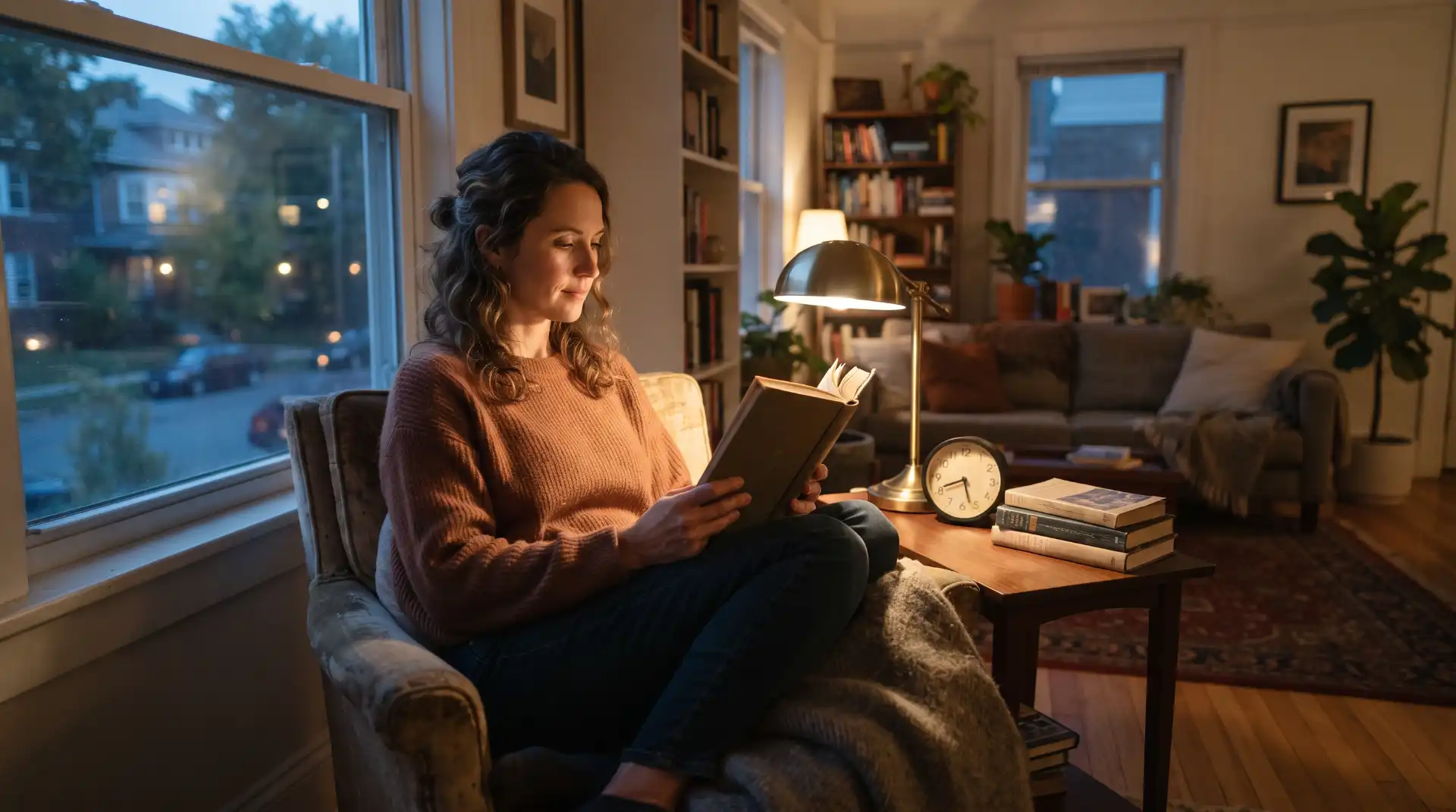
Reading Goals Are Changing
Traditional reading goals usually focus on numbers.
Read 25 books.
Read 50 books.
Read 100 books.
Those goals remain useful for readers who find them motivating.
Slow readers are experimenting with different goals.
Instead of counting books, someone might aim to read for thirty uninterrupted minutes each evening.
Another person might finally read three major classics they have postponed for years.
Someone else might focus on one long nonfiction book each month.
A reader may choose to reread five favorites.
The emphasis shifts from output to experience.
This can also reduce guilt.
Falling behind on an annual challenge can create unnecessary pressure around an activity that is supposed to be enjoyable.
Removing the target allows reading to return to curiosity.
Slow Reading May Help Readers Remember More
Many readers know the strange feeling of finishing a book and barely remembering it six months later.
Part of that is normal.
Human memory fades.
But rapidly moving from one book to another can create additional blending.
Characters, plots, and ideas begin overlapping.
Slow reading creates pauses.
Reflection gives the brain more opportunities to connect information with existing knowledge.
Talking about a book, writing about it, or simply thinking about it between reading sessions can reinforce those connections.
Longer books may also create more opportunities for repeated exposure to characters and themes.
The same names and ideas appear across hundreds of pages.
Readers gradually build mental models of the story.
This does not mean slow reading guarantees perfect memory.
It means reading can become more than immediate consumption.
The book has time to settle.
Book Clubs Can Encourage Slower Reading
Book clubs provide another natural environment for slow reading.
A group reading one book over several weeks creates a different pace than a person racing through a stack alone.
Members often stop at predetermined chapters.
They think about questions before meetings.
They hear interpretations they might never have considered.
Interestingly, Pew’s 2026 survey found that formal book-club participation remains relatively uncommon. Only a minority of American adults reported being in one, even though book reading itself remains widespread.
That leaves substantial room for informal reading communities.
Friends can read a long novel together without creating a formal club.
Online communities can dedicate months to classics.
Families can share books.
Libraries can host seasonal reading groups.
Slow reading becomes easier when readers know other people are progressing at the same relaxed pace.
Libraries Fit Naturally Into the Movement
Libraries may also benefit from renewed interest in deliberate reading.
A library provides something digital platforms often struggle to offer: a physical environment dedicated to books without pressure to purchase constantly.
Readers can browse slowly.
They can experiment with unfamiliar authors.
They can borrow a long book without worrying about whether buying it is worth the cost.
Libraries also preserve backlists.
Social media tends to favor whatever is currently receiving attention.
A library shelf does not care whether a novel appeared on a trending list this week.
A book from 1975 can sit beside one published last month.
That makes libraries ideal spaces for readers who want to escape the pressure of constant novelty.
There Is Still Room for Short Books
Slow reading should not become another rule readers feel obligated to follow.
Longer is not automatically better.
Novellas can be brilliant.
Poetry collections may be brief but require extraordinary attention.
Essays can fit enormous ideas into a few pages.
A short novel read thoughtfully may provide a deeper experience than a massive book rushed through for status.
The real issue is intentionality.
A reader should not choose a 150-page book only because it produces another checkmark.
Likewise, someone should not choose a 900-page novel simply because slow reading has become fashionable.
The right book is the one the reader genuinely wants to spend time with.
Publishers May Benefit From Readers Embracing Length Again
If readers become less intimidated by long books, publishers may gain more flexibility.
Editors and authors constantly make decisions about length.
Some stories need space.
A historical novel may require extensive worldbuilding.
A biography may need hundreds of pages to present a complicated life fairly.
A fantasy writer may need multiple plotlines to build a convincing world.
When readers strongly favor speed and short completion times, large books face a psychological disadvantage before anyone reads the first page.
Slow reading reduces that disadvantage.
Readers who plan to spend several weeks on one book may care less whether it contains 400 pages or 700.
That does not mean publishing is suddenly moving toward enormous books across every genre.
Rather, the cultural conversation around reading may become more accepting of books that demand substantial time.
The Trend Fits a Wider Desire for Intentional Living
Slow reading is ultimately about more than books.
It reflects a broader desire to experience life without turning every activity into a race.
People are increasingly aware of what constant notifications, scrolling, and rapid media consumption feel like.
That does not mean Americans are abandoning technology.
They are choosing moments when they do not want it controlling the pace.
Reading offers one of those moments.
A person can sit with a book for an hour and encounter only what the author placed on the page.
No algorithm needs to decide what comes next.
No notification needs an immediate response.
No public leaderboard needs another completed title.
The reader controls the pace.
That may be one of the simplest reasons slow reading is appealing.
What American Reading Habits Tell Us
The slow reading trend should not be interpreted as evidence that everyone is suddenly abandoning digital media for giant novels.
U.S. reading habits are more complicated.
According to Pew Research Center’s 2026 analysis, three-quarters of American adults had read all or part of at least one book during the previous year. Print remained dominant, but e-books and audiobooks had grown substantially compared with 2011.
That suggests the future of reading is not about one format replacing another.
Readers are building mixed habits.
Someone may use an audiobook during a commute, an e-reader while traveling, and a hardcover novel at home.
Slow reading can exist across all three.
The important change is mindset.
Instead of constantly looking toward the next book, readers give the current one more attention.
Authoritative External Resource: For current data on American reading habits and book formats, readers can explore the Pew Research Center’s 2026 analysis of U.S. book reading.
Is Slow Reading Right for Every Reader?
Probably not.
Some readers naturally love consuming books quickly.
They remember stories easily and enjoy moving rapidly between genres.
Others genuinely find motivation in annual reading challenges.
There is nothing wrong with either approach.
Slow reading becomes useful when quantity starts reducing enjoyment.
If a reader feels anxious because a book is taking too long, avoiding long novels because they affect an annual count, or selecting books mainly to reach a numerical target, slowing down may offer relief.
The idea is not to create another identity.
There is no need to become a “slow reader.”
There is only permission to read at the pace that makes books enjoyable.
A Better Way to Think About Reading Success
Reading success is difficult to measure.
Is the person who finishes 100 books more successful than someone who finishes twelve?
Not necessarily.
The twelve books may become lifelong favorites.
They may change the person’s perspective.
One may inspire a career decision.
Another may introduce an unfamiliar culture.
A third may simply provide comfort during a difficult month.
Books matter in ways annual totals cannot capture.
That is perhaps the central idea behind slow reading.
The number of completed titles is real, but it is only one measurement.
The better questions might be these:
Did the book stay with you?
Did you enjoy the time spent reading it?
Did it make you think?
Would you return to it?
Would you tell someone else about it years later?
Those questions cannot fit neatly inside a progress bar.
The Future May Belong to More Intentional Readers
American readers do not appear to be moving toward a single style of reading.
Digital formats are growing.
Audiobooks continue expanding.
Print remains widely used.
Social platforms still influence discovery.
AI-powered reading tools are emerging.
At the same time, readers are rediscovering the appeal of simply spending more time with a book.
These trends are not necessarily contradictory.
Technology can make books easier to access while readers become more selective about where they place their attention.
A person can discover a novel through BookTok and then spend six weeks reading it slowly.
Someone can purchase an e-book instantly and still ignore every other app while reading it.
A listener can spend a month carefully working through a 30-hour audiobook.
Slow reading is not a rejection of modern reading culture.
It is a correction to one part of it.
Reading Does Not Need to Be a Race
Books have never asked readers to hurry.
A long novel waits exactly where someone leaves it.
A classic does not expire because it was not finished this month.
A reading list does not become meaningless because only half of it was completed.
Readers create most of that pressure themselves, often with help from apps and social comparison.
Slow reading offers another option.
Choose fewer books.
Choose longer books if they interest you.
Reread something.
Spend ten minutes thinking about a paragraph.
Leave the phone somewhere else.
Stay with one fictional world for several weeks.
There is no prize for reaching the final page first.
For readers who feel exhausted by the pressure to consume more, slow reading can return books to what they were supposed to be all along: a place to spend time, not another task to complete.
The future of reading may involve sophisticated e-books, artificial intelligence, immersive audiobooks, and increasingly powerful recommendation systems.
Yet one of the most meaningful trends may also be one of the simplest.
Open one good book.
Stay with it.
And do not worry about what you are reading next until you are ready.