

Reading in America looks very different from the way it did a generation ago. A reader walking into a bookstore today may leave with a hardcover novel, download the same title to an e-reader, or listen to it through a smartphone before arriving home.
The modern reading experience is no longer defined by one physical format.
Print books, ebooks, and audiobooks have each developed their own place in American reading culture. Instead of completely replacing one another, these formats increasingly exist side by side, giving readers more choices about when, where, and how they experience a story.
For some Americans, nothing compares with turning the pages of a physical book. Others appreciate having an entire library stored on a lightweight device. Audiobooks have created another option for people who want to experience books while driving, exercising, cooking, commuting, or completing household tasks.
This new flexibility is changing the meaning of reading itself.
In this guide, we will compare print books, ebooks, and audiobooks, examine their advantages and limitations, and explore how American readers are choosing between formats in 2026.
How Reading Has Changed in the United States
The American book market has experienced significant changes over the past two decades.
The arrival of dedicated e-readers and ebook marketplaces changed how consumers purchased and stored books. Smartphones then made digital reading even more accessible. Audiobook platforms expanded the definition of reading again by allowing people to experience books through narration rather than visually reading text.
At the same time, physical books remained remarkably resilient.
Bookstores continue to operate across the United States, libraries maintain extensive print collections, and many readers continue to prefer physical copies for their personal libraries.
The result is not a simple transition from print to digital.
Instead, American reading culture has become increasingly multi-format.
A person might purchase a hardcover edition of a favorite novel, read a different book on an e-reader while traveling, and listen to an audiobook during a commute.
The format can change depending on the situation.

Print Books: The Traditional Format Still Has a Strong Following
Print books remain one of the most recognizable forms of reading in America.
There is something tangible about a physical book that digital formats cannot completely reproduce. Readers can see the cover, feel the paper, flip through pages, write notes in the margins, place bookmarks between chapters, and display books on shelves.
For many people, these physical characteristics are part of the reading experience.
Print books also create a clear separation between reading and other digital activities.
An e-reader can be dedicated to books, but smartphones and tablets can contain notifications, social media apps, email, games, and other distractions. A physical book has fewer competing functions.
That can make the experience feel more intentional.
Why Americans Continue Buying Print Books
One reason print remains popular is that books can become personal objects.
A physical book can remind someone of a vacation, a school experience, a recommendation from a friend, or a particular period of life.
People can also lend physical books to family members and friends.
Book collections can become part of a home’s personality. A shelf filled with novels, biographies, cookbooks, history books, or children’s books can reflect the interests of the people who live there.
For some readers, collecting books is almost as important as reading them.
Print books also remain important in schools, libraries, bookstores, and educational settings throughout the United States.
The Reading Experience of Print Books
Physical reading provides a tactile experience that many readers find satisfying.
The weight of a hardcover book, the texture of the paper, and the physical progress through the pages can provide a sense of accomplishment.
There is also a natural sense of location.
Readers can remember that an important passage appeared near the bottom of a particular page or somewhere toward the beginning of a chapter.
This physical orientation can make it easier for some people to remember where information appeared.
However, print books also have practical disadvantages.
They take up physical space, can be heavy when traveling, and may cost more than some digital alternatives. A person who reads several books each month may quickly accumulate boxes or shelves of books.
For people living in smaller apartments or frequently traveling, that can become an important consideration.
Ebooks: A Library That Fits in Your Bag
Ebooks changed reading by removing the physical boundaries of a book.
Instead of carrying several novels, readers can store hundreds or even thousands of digital books on a single device.
This is particularly useful for travelers.
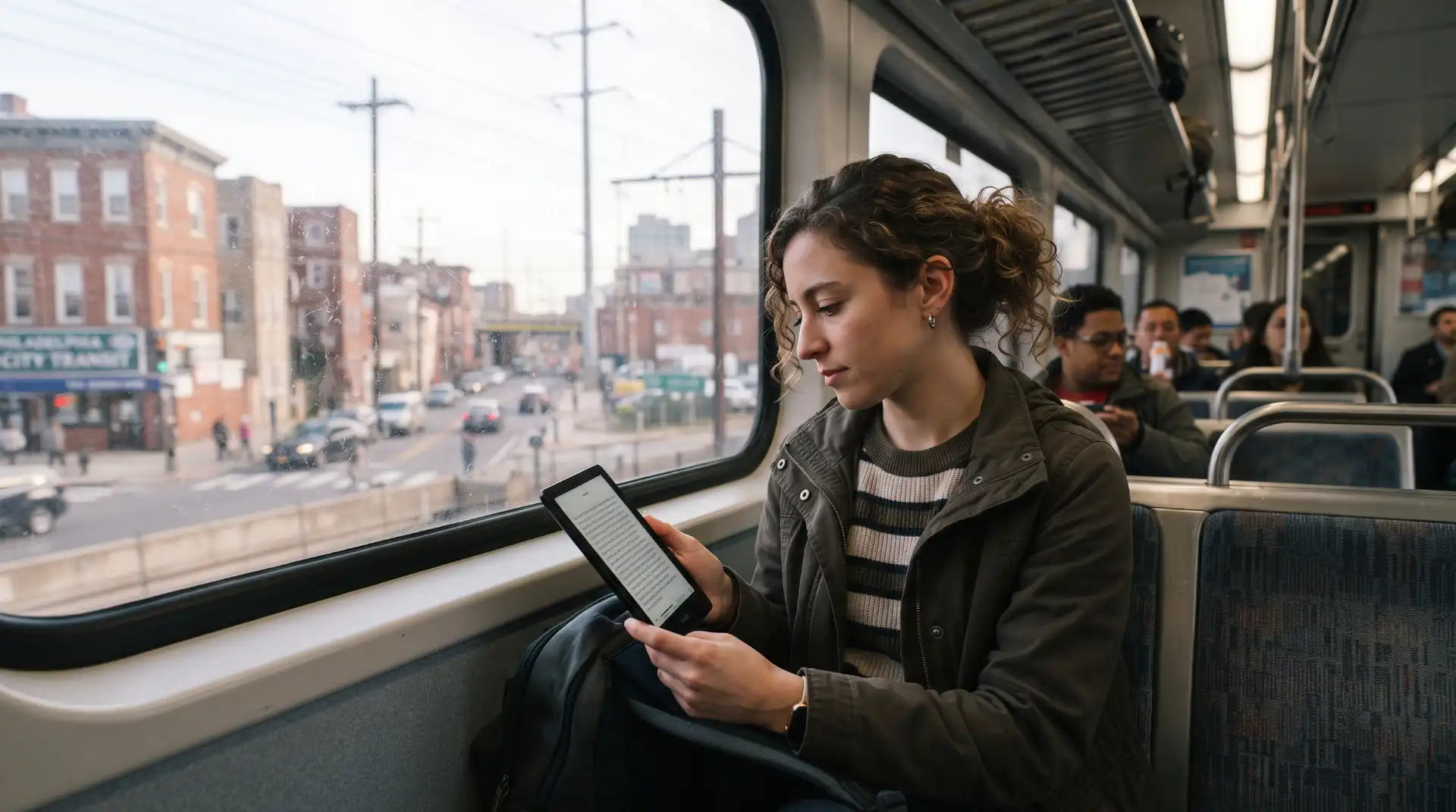
An American reader flying across the country can carry an entire reading list without adding much weight to their luggage.
Ebooks can also offer adjustable text sizes, built-in dictionaries, search functions, bookmarks, and other accessibility features.
For readers with certain visual needs, adjustable fonts and display settings can make digital books easier to read.
The convenience of ebooks has helped establish them as a permanent part of the American reading landscape.
Why Readers Choose Ebooks
Convenience is one of the biggest advantages of ebooks.
A reader can purchase a title from home and begin reading almost immediately. There is no need to wait for shipping or visit a physical bookstore.
Ebooks can also make it easier to maintain multiple books at once.
Someone researching American history, for example, could keep several reference books on one device and search within them quickly.
Students can benefit from similar features when managing reading assignments.
Another advantage is portability.
A smartphone or tablet can provide access to a large digital library without requiring a physical bookshelf.
For frequent travelers, commuters, and people who move often, that flexibility can be valuable.
The Limitations of Ebooks
Despite their convenience, ebooks are not perfect for every reader.
Digital reading requires a compatible device, and many devices require charging.
Some readers also experience screen fatigue after spending long periods looking at phones, tablets, or computers.
Dedicated e-readers can reduce some of these issues, but they still represent another electronic device that needs to be purchased and maintained.
There is also a psychological difference between owning a physical object and accessing a digital file.
Some readers simply prefer the permanence and presence of a physical book.
That preference remains an important reason print continues to coexist with ebooks.
Audiobooks: Reading Without Looking at a Page
Audiobooks have introduced another major change to American reading habits.
Instead of reading printed or digital words, listeners experience a book through spoken narration.
A narrator may read the entire book, sometimes using different voices, pacing, and emotional expression to distinguish characters and scenes.
Audiobooks can turn otherwise unavailable time into listening time.
A person can listen while commuting to work, walking through a neighborhood, preparing dinner, cleaning the house, or exercising.
This is one reason audiobooks have become particularly useful for people with busy schedules.

Why Audiobooks Are Growing in Popularity
Modern American life can make it difficult to find uninterrupted time to sit down with a book.
Audiobooks provide another solution.
Instead of waiting for an hour of free time, a reader can listen for fifteen or twenty minutes while performing another activity.
This does not necessarily replace visual reading.
Many people use audiobooks alongside print and ebooks.
For example, someone might listen to a novel during their morning commute and continue reading the physical copy at home.
That flexibility makes audiobooks particularly adaptable to modern lifestyles.
The Audio Publishers Association has reported continued growth in audiobook listening and consumer engagement, making the format an important part of the U.S. publishing market.
For current industry information, readers can explore the Audio Publishers Association for research and resources about audiobook consumption in the United States.
The Unique Experience of Listening to a Book
Audiobooks create a different relationship between the reader and the story.
A skilled narrator can add emotion, rhythm, humor, suspense, and personality.
Some audiobook productions also use multiple performers or additional production elements.
This can make certain stories feel closer to a theatrical performance than conventional reading.
For fiction, narration can be particularly powerful.
A narrator can influence how a character’s personality is perceived, how a dramatic scene feels, and how quickly the story develops.
For nonfiction, narration can create a conversational quality that makes complex topics feel more approachable.
Audiobooks Are Not Always the Best Choice for Every Situation
Listening has its own limitations.
It can be difficult to concentrate on an audiobook in a noisy environment.
Driving requires attention to the road, so listeners may miss details when traffic becomes complicated or when they become distracted.
Similarly, listening while multitasking can result in reduced comprehension.
This is one reason some readers prefer print or ebooks when studying, researching, or carefully analyzing a text.
The format should match the purpose.
If the goal is deep analysis, a physical or digital text may provide easier access to specific passages.
If the goal is entertainment during a commute, an audiobook may be more practical.
Print Books vs. Ebooks vs. Audiobooks
The differences between the three formats become clearer when considering specific reading situations.
| Reading Need | Print Books | Ebooks | Audiobooks |
|---|---|---|---|
| Physical collection | Excellent | Limited | None |
| Portability | Moderate | Excellent | Excellent |
| Hands-free use | No | No | Yes |
| Adjustable text | No | Yes | Not applicable |
| Easy searching | Limited | Excellent | Usually available through apps |
| Screen-free reading | Yes | Usually | Yes |
| Multitasking | Limited | Limited | Excellent |
| Lending | Easy for physical copies | Depends on platform | Depends on service |
| Shelf display | Yes | No | No |
| Narrated experience | No | Usually no | Yes |
The comparison shows why no single format has eliminated the others.
Each one solves different problems.
Which Format Is Best for Travel?
Travel is one area where digital formats have a clear practical advantage.
A physical book may be perfectly comfortable for a short trip, but someone planning a long vacation might want several books available.
An e-reader can hold an extensive library without significantly increasing luggage weight.
Audiobooks are also useful for travel, particularly during road trips.
A family traveling from Los Angeles to San Francisco, for example, can listen to a novel or nonfiction title during the drive.
For air travel, an e-reader or physical book may be more appropriate during periods when passengers cannot use electronic devices.
Many travelers therefore combine formats.
Which Format Is Best for Focus?
Focus depends heavily on the individual reader and environment.
A physical book can create a distraction-free experience because it does not display notifications.
A dedicated e-reader can offer similar benefits while providing digital convenience.
Audiobooks can work well when the listener has a repetitive task that does not require significant concentration.
The important distinction is that listening while multitasking is not always equivalent to sitting down and reading.
A reader studying a difficult historical text may want the ability to stop, reread a paragraph, highlight a passage, or consult a previous section.
Print and ebooks make these actions relatively straightforward.
Which Format Is Best for Students?
Students in the United States may use all three formats depending on the assignment.
Print books remain common for textbooks, library materials, and long-form academic reading.
Ebooks can be useful when students need search functions, adjustable text, or access to multiple sources.
Audiobooks can support students who benefit from listening or who want to review material while commuting.
However, students should consider the specific requirements of an assignment.
Close reading, citation, and detailed analysis may be easier with a visual copy of the text.
For general exposure to a subject, an audiobook can provide another useful entry point.
The Role of Libraries in the New Reading Era
American libraries have adapted to the changing reading environment by offering multiple formats.
A modern library may provide physical books, ebooks, audiobooks, magazines, graphic novels, and digital databases.
This gives readers more choice without requiring them to purchase every format themselves.
Libraries are also important because they help reduce the cost barrier associated with reading.
Someone who cannot afford to buy several books every month can borrow physical copies or use digital lending services where available.
The result is a reading environment where format choice does not have to depend entirely on personal purchasing power.
Are Physical Books Becoming Obsolete?
The continued popularity of print suggests otherwise.
Digital formats have changed the publishing industry, but physical books continue to attract readers.
Their persistence is partly explained by the emotional and physical qualities associated with ownership.
People give books as gifts. They collect favorite authors. Parents read physical books with children. Students annotate printed materials. Readers display books in their homes.
These behaviors are difficult to reproduce digitally.
At the same time, digital formats provide advantages that print cannot easily match.
The important trend is therefore coexistence rather than complete replacement.
The Rise of Hybrid Reading
One of the most interesting developments in modern reading is hybrid reading.
A hybrid reader does not necessarily identify with one format.
Instead, the reader chooses the format based on circumstances.
A novel might begin as an ebook, continue as an audiobook during a commute, and end as a print edition purchased for a personal collection.
The content remains the same, but the experience changes.
This flexibility reflects a broader shift in American consumer behavior.
People increasingly expect services to adapt to their routines.
Reading is following the same pattern.
How Technology Is Changing Book Discovery
Technology has changed not only how Americans read but also how they discover books.
Social media platforms, online bookstores, podcasts, newsletters, video creators, and reading communities can introduce readers to titles they might never encounter in a traditional bookstore.
BookTok and other online communities have become important parts of this discovery process.
Readers may see a recommendation online and immediately search for a print, ebook, or audiobook edition.
This means technology connects the different reading formats rather than simply replacing one with another.
A digital recommendation can ultimately result in the purchase of a physical book.
The Environmental Question
The environmental impact of different book formats is more complicated than simply labeling one option as environmentally friendly.
Print books require paper, printing, transportation, packaging, and physical storage.
Digital formats reduce the need for physical production and shipping but require electronic devices, energy, data infrastructure, and manufacturing.
The environmental impact also depends on how frequently a device is used and how many physical books are purchased, transported, or shared.
For readers concerned about sustainability, borrowing books from libraries, purchasing used books, keeping books for long periods, and using existing electronic devices can all be considerations.
There is no single simple answer for every reader.
The Economics of Reading
Price can also influence format choices.
A new hardcover book may cost more than a discounted ebook, while an audiobook subscription may provide access to titles under specific service conditions.
Used bookstores offer another option for people who prefer physical books at lower prices.
Libraries provide perhaps the most important alternative because they allow readers to access books without purchasing them individually.
The best financial choice depends on how frequently someone reads, what types of books they want, and whether they are willing to buy new, used, or digital editions.
Reading Is Becoming More Personalized
The biggest change may be that Americans now have more control over how they read.
Someone who dislikes screens can choose print.
Someone who travels frequently can use an e-reader.
Someone with a busy schedule can listen to audiobooks.
Someone who enjoys collecting can build a physical library.
And someone who wants maximum flexibility can combine all three.
This personalization is likely to remain a defining characteristic of reading in the United States.
The future of reading is not necessarily about choosing one format.
It is about having the freedom to choose the format that works for a particular moment.
What the Future May Look Like
Print books, ebooks, and audiobooks are likely to continue developing alongside one another.
Publishing companies can release the same title across several formats, allowing readers to decide how they want to experience it.
Technology may also make switching between formats increasingly seamless.
A reader might begin an ebook in the morning, continue listening to the audiobook during a commute, and return to the ebook at night.
Digital ecosystems already make this kind of behavior possible in some circumstances, and future services may make it even easier.
Meanwhile, physical books are likely to retain their cultural importance because they provide something digital formats cannot completely replicate: a tangible object that can be owned, displayed, shared, collected, and revisited.
Final Thoughts: There Is No Single Way to Read
The new era of reading is defined by choice.
Print books provide a tangible and focused experience. Ebooks offer portability, convenience, and digital features. Audiobooks transform books into experiences that can fit into otherwise occupied parts of the day.
None of these formats needs to eliminate the others.
For American readers in 2026, the most useful question may not be which format is replacing another.
Instead, ask which format fits the moment.
A quiet Sunday afternoon may be perfect for a hardcover novel.
A cross-country flight may call for an e-reader.
A morning commute may be ideal for an audiobook.
The same reader can enjoy all three.
That flexibility is one of the most positive developments in modern reading culture. Books are becoming more adaptable to the way people actually live, work, travel, study, and relax.
The future of reading may therefore be less about print versus digital and more about giving readers the freedom to choose.
And in an increasingly busy American society, having more ways to experience a good book can only make the reading experience more accessible to different kinds of readers.