

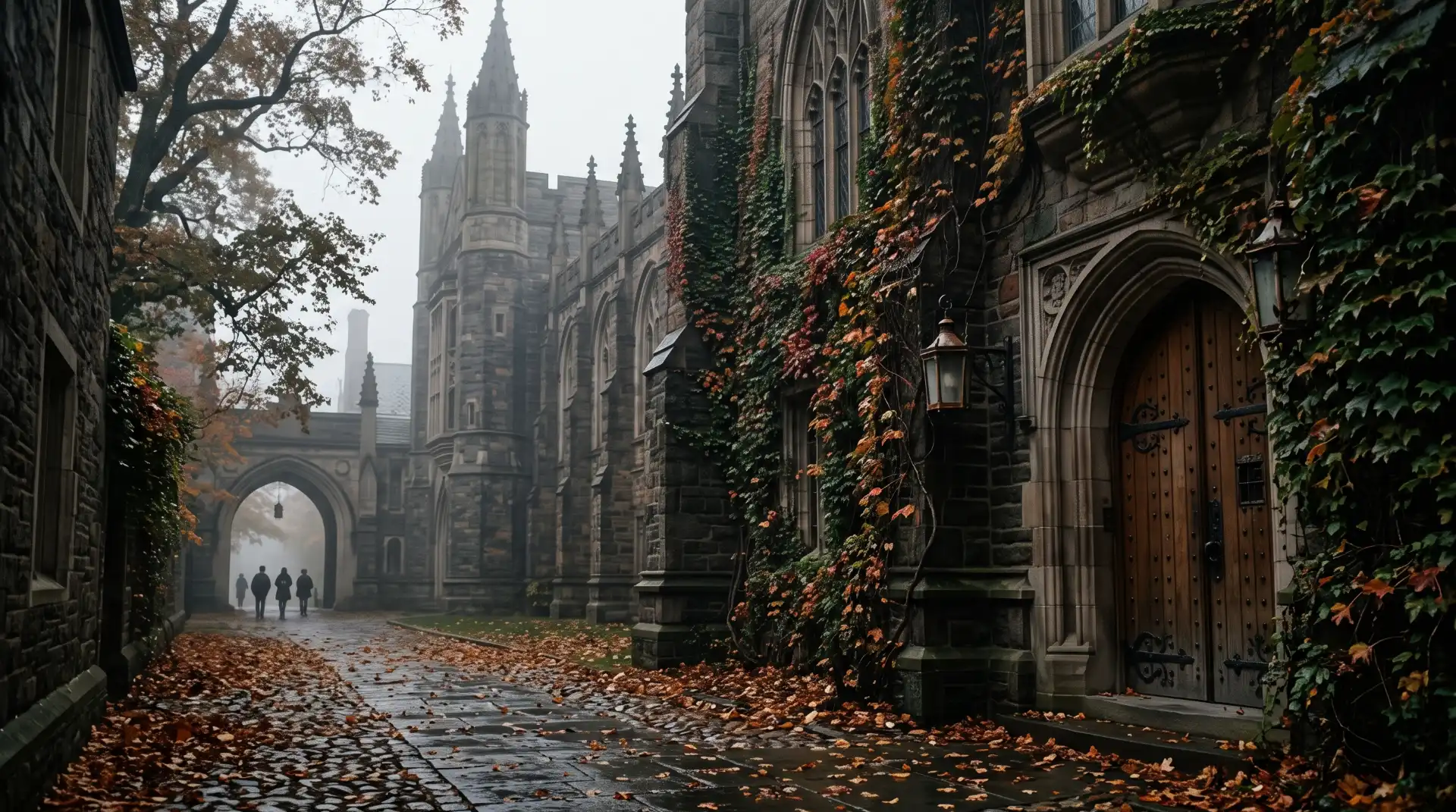
A historic university library after sunset can feel like a world separate from everyday life. Rain taps against tall windows, old books line the walls, and the last students leave quiet reading rooms illuminated by warm desk lamps. Somewhere beyond the library, an academic society meets behind a locked door, a professor guards a troubling secret, or a student discovers information that could change everything.
This atmosphere captures the growing appeal of dark academia, a literary genre that combines intellectual ambition, Gothic settings, psychological suspense, and the complicated relationships that develop inside exclusive academic communities. Its stories frequently take place at prestigious colleges, private boarding schools, graduate programs, and institutions where knowledge promises opportunity but can also become a source of obsession, competition, and danger.
For American readers, dark academia offers a fascinating perspective on campus life. College is often associated with independence, personal growth, and intellectual discovery, yet the experience can also involve intense competition, social pressure, financial uncertainty, and the desire to belong. Dark academia transforms these recognizable experiences into mysteries that explore what happens when ambition becomes more important than honesty, loyalty, or personal responsibility.
The genre is also attractive because it creates an immersive reading experience. Antique libraries, classical literature, handwritten notes, autumn landscapes, and historic architecture establish a distinctive mood. However, the best dark academia books are not simply collections of beautiful settings. They examine the darker consequences of human behavior, the influence of powerful institutions, and the secrets people keep to protect their reputations.
Whether you enjoy murder mysteries, literary fiction, supernatural suspense, or academic fantasy, there are many ways to explore this genre. The following guide examines ten compelling books, explains the themes that make dark academia distinctive, and offers practical advice for building a reading list that suits your interests.
What Is Dark Academia?
Dark academia is a literary genre and cultural aesthetic centered on education, intellectual pursuits, artistic ambition, and the unsettling aspects of academic life. Its stories often involve universities, boarding schools, libraries, museums, and other environments associated with learning and cultural prestige.
Traditional campus fiction may focus on student friendships, academic careers, romance, or the transition into adulthood. Dark academia introduces a more mysterious atmosphere. An admired professor might be hiding unethical behavior, a prestigious institution might be protecting its reputation, or a group of talented students might become involved in a secret that threatens their future.
The genre does not follow a single formula. Some novels are realistic psychological thrillers, while others incorporate supernatural forces, historical fantasy, Gothic horror, or satire. Their shared interest lies in the relationship between intellectual ambition and human vulnerability.

Why Readers Are Drawn to the Aesthetic
The atmosphere of dark academia is one of its most recognizable features. Historic buildings, secluded courtyards, candlelit rooms, classical music, and old libraries create a sense of timelessness. These settings can feel comforting because they suggest quiet concentration and a deep connection to literature, history, and art.
Yet the same environments can become unsettling when their histories are examined closely. A locked archive might contain evidence of a forgotten scandal, an academic tradition might have disturbing origins, or an exclusive society might use its influence to control students.
This contrast between beauty and danger makes the genre particularly effective. The reader is drawn into an attractive environment before gradually discovering that its elegance conceals complicated relationships and unresolved conflicts.
Intellectual Ambition and Moral Conflict
Dark academia characters frequently pursue excellence in literature, philosophy, history, art, languages, or other demanding disciplines. Their interests shape their identities and influence how they understand the world.
However, academic achievement does not necessarily make these characters ethical or emotionally mature. A brilliant student might manipulate classmates to protect a scholarship, while an influential professor might exploit the admiration of students who want to succeed.
These conflicts challenge the assumption that intelligence automatically produces wisdom. Characters may understand complex philosophical arguments yet struggle to recognize the consequences of their own actions. Their education can even provide sophisticated explanations for behavior that should never have been justified.
For readers, this creates opportunities to examine the difference between knowing what is right and being willing to do it.
Social Media and the Rise of Dark Academia
Online reading communities have helped dark academia reach a wider audience. Readers share photographs of antique books, Gothic architecture, annotated novels, autumn reading lists, and vintage stationery. Short-form videos and recommendation posts allow people to discover books based on atmosphere, themes, and emotional appeal rather than traditional genre labels alone.
This culture has helped connect literary fiction with fantasy, horror, and psychological suspense. A reader searching for an atmospheric university mystery may discover a supernatural thriller, while someone interested in classical literature might find a story about dangerous academic rivalries.
Still, visual appeal should not be confused with literary depth. The strongest dark academia novels use their atmosphere to investigate questions about identity, privilege, power, and belonging. Those themes give the stories lasting interest beyond their recognizable aesthetic.
10 Best Dark Academia Books for Mystery, Secrets, and Campus Fiction
The following recommendations explore different sides of dark academia. Some focus on realistic psychological tension, while others introduce supernatural mysteries, artistic competition, or political questions about education and power.
1. The Secret History by Donna Tartt
First published in 1992, The Secret History is widely associated with the modern dark academia tradition. Donna Tartt’s novel follows a group of classics students at a small Vermont college who become increasingly isolated from the rest of campus under the influence of a charismatic professor.
The students share a fascination with ancient Greek literature, philosophy, and intellectual distinction. Their studies help create a private world in which ordinary social expectations seem less important than the group’s ambitions and shared interests.
As their relationships develop, admiration turns into rivalry, loyalty becomes complicated, and the students make decisions with consequences they cannot fully control. The novel reveals its central tragedy early, allowing the narrative to focus on the psychological and social circumstances that lead to disaster.
One of the book’s greatest strengths is its examination of group behavior. Each character has individual motivations, but the group’s collective identity influences what its members believe they can justify. Fear of exclusion and the desire to preserve a privileged position make it increasingly difficult for anyone to challenge the group’s decisions.
The academic setting reinforces these themes. Classical literature provides the characters with a framework for interpreting their lives, yet their intellectual sophistication does not prevent them from making destructive choices. Knowledge becomes part of their identity without guaranteeing moral judgment.
For American readers interested in elite college culture, psychological suspense, and complicated friendships, this novel is an essential starting point. It is particularly suitable for those who enjoy slow-building tension and morally ambiguous characters.
2. If We Were Villains by M. L. Rio
M. L. Rio’s If We Were Villains explores dark academia through Shakespearean theater. The novel follows a group of students at an elite conservatory whose lives revolve around acting, artistic competition, and the study of dramatic literature.
The students become deeply involved in their theatrical roles, and the boundary between performance and personal identity gradually begins to blur. Shakespeare’s tragedies influence how they interpret relationships, express rivalries, and respond to the conflicts developing within their circle.
When a death disrupts the group, the story examines the events and relationships surrounding the tragedy. Memory, loyalty, and conflicting interpretations become central to the mystery.
The theatrical environment makes the story especially compelling. Actors practice adopting identities, expressing emotions, and presenting convincing versions of reality. These abilities become more troubling when the students begin to conceal their own feelings and motivations.
The novel also explores the pressures of belonging to a small artistic community. Students depend on one another for performance opportunities and professional development, making it difficult to separate friendship from competition.
Readers who enjoy Shakespeare, dramatic dialogue, and mysteries involving unreliable memories will appreciate this novel. It is an excellent choice for those who want a campus mystery with an artistic focus rather than a traditional university setting.
3. Ninth House by Leigh Bardugo
Leigh Bardugo’s Ninth House combines dark academia with supernatural suspense. Set around Yale University, the novel introduces a hidden world in which powerful student societies engage in occult activities.
The protagonist, Alex Stern, receives an unusual opportunity to attend Yale after surviving a difficult past. Her responsibilities introduce her to secret rituals and organizations whose activities remain invisible to most students and faculty members.
The societies represent more than mysterious campus clubs. They possess social influence and institutional connections that make their activities difficult to challenge. Their secrecy raises questions about who receives protection and what happens when influential people believe ordinary rules do not apply to them.
Alex’s outsider status strengthens the narrative. She must navigate an unfamiliar social hierarchy while investigating events that are difficult to explain through conventional reasoning. Her position encourages her to question official accounts and examine the relationship between privilege and accountability.
The supernatural elements distinguish Ninth House from realistic campus thrillers. Magic makes institutional secrecy literal, creating a world where dangerous rituals exist alongside familiar university life.
Nevertheless, the novel’s underlying concerns remain recognizable. It explores power, exclusion, vulnerability, and the consequences of entering a world whose rules are designed by people who already control it.
Readers who enjoy occult mysteries, Gothic atmosphere, and contemporary fantasy will find this a compelling choice.
4. Babel: Or the Necessity of Violence by R. F. Kuang
R. F. Kuang’s Babel: Or the Necessity of Violence combines historical fantasy with an examination of language, empire, and institutional power. Set in an alternative nineteenth-century Oxford, the novel follows students at a prestigious institute where translation supports an extraordinary magical system.
The institution offers intellectual opportunities, but its success depends on unequal relationships between cultures and nations. Education becomes inseparable from political influence, economic interests, and the exploitation of knowledge.
Language is central to the story. Translation is not merely an academic exercise; it becomes a source of power with consequences that extend beyond the classroom. The novel asks who benefits from intellectual achievement and who bears the cost of maintaining the institutions that make it possible.
This approach expands dark academia beyond the secrets of a small group of students. Kuang examines how an institution can promote scholarship and progress while participating in broader systems of inequality.
The novel is particularly suitable for readers who enjoy elaborate world-building, historical settings, and fantasy that encourages debate. Its themes provide opportunities to consider the responsibilities of scholars and the relationship between education and political authority.
For book clubs, Babel offers a strong foundation for discussions about language, identity, cultural power, and the ethical consequences of benefiting from unequal systems.
5. Bunny by Mona Awad
Mona Awad’s Bunny takes dark academia in a surreal and psychologically unsettling direction. The novel follows Samantha, a scholarship student in a graduate creative-writing program who feels alienated from a group of wealthy, closely connected classmates.
The classmates use an affectionate nickname for one another and appear to share a private social world that Samantha finds difficult to understand. When she receives an invitation to join their circle, her experience becomes increasingly strange.
The novel examines the desire for acceptance and the pressure to conform within academic communities. Students may feel compelled to adopt particular identities, imitate influential peers, or suppress their individuality to avoid exclusion.
Awad transforms these familiar pressures into an unpredictable narrative that moves between satire, psychological suspense, and surreal horror. The result is not a conventional murder mystery but an exploration of loneliness, artistic identity, and the uneasy relationship between imagination and reality.
Its unusual tone will not appeal to every reader, particularly those who prefer straightforward plots. However, readers who enjoy experimental fiction may find its unpredictability refreshing.
Choose Bunny if you want dark academia that challenges expectations and explores the emotional complications of graduate-school culture.
6. I Have Some Questions for You by Rebecca Makkai
Rebecca Makkai’s I Have Some Questions for You combines a boarding-school setting with a mystery that reaches into adulthood. The protagonist, Bodie Kane, is a successful film professor and podcaster who returns to the New Hampshire boarding school she once attended.
During her school years, another student was murdered. Bodie’s return prompts her to reconsider the case and question the version of events that became accepted by the surrounding community.
The novel explores the reliability of memory and the influence of reputation. People remember events differently, and their accounts may be shaped by loyalty, prejudice, personal interests, or the passage of time.
The school setting is important because institutions have reasons to protect their reputations. A respected educational community may be reluctant to revisit a scandal that could damage its public image or expose failures in its handling of past events.
Rather than relying on constant dramatic revelations, the mystery develops through conflicting accounts and the gradual reconsideration of familiar assumptions.
Readers who enjoy realistic investigations, character-driven suspense, and stories about institutional responsibility will appreciate this novel. It is also an excellent choice for book clubs because its questions about memory, justice, and accountability invite thoughtful discussion.
7. A Lesson in Vengeance by Victoria Lee
Victoria Lee’s A Lesson in Vengeance brings Gothic suspense into the world of an elite boarding school. The story follows Felicity Morrow as she returns to Dalloway School, a place associated with the deaths of former students and rumors of witchcraft.
The institution’s history becomes central to the mystery. Stories about earlier students create an atmosphere in which the past seems to influence the present, while the school’s traditions provide clues that may help explain its disturbing reputation.
Felicity’s relationship with another student, Ellis Haley, draws her further into the investigation. Their interactions complicate the distinction between friendship, fascination, and manipulation.
The novel creates suspense through uncertainty. Historical records, personal memories, and rumors provide competing explanations, while the characters’ own motivations make it difficult to determine which accounts deserve trust.
Its Gothic setting emphasizes isolation and psychological tension. The school appears orderly, yet its traditions suggest that some aspects of its history remain unresolved.
Readers who enjoy boarding-school mysteries, unreliable perspectives, and supernatural ambiguity will find this an appealing option. It also explores grief, ambition, and the desire to control how others perceive us.
8. The Ivies by Alexa Donne
Alexa Donne’s The Ivies brings dark academia into the competitive world of American college admissions. Set at an elite preparatory school, the novel follows ambitious students determined to secure places at prestigious universities.
Academic achievements become more than personal accomplishments. Admission represents status, opportunity, and future success, creating an environment where classmates may view one another as competitors rather than friends.
The novel combines young adult suspense with a mystery that reveals the consequences of excessive academic pressure. The students’ ambitions create complicated relationships in which loyalty and competition become difficult to separate.
Although the story takes place in high school rather than college, it fits comfortably within the broader dark academia tradition. Its institution determines social standing and encourages students to believe that extraordinary achievement is worth considerable sacrifice.
For readers interested in selective admissions, academic rivalry, and fast-paced suspense, The Ivies provides a contemporary alternative to the slower, more literary novels on this list.
It also raises questions about the difference between healthy ambition and destructive competition. Achievement can open doors, but when success becomes the only acceptable outcome, students may lose sight of their values and relationships.
9. Never Let Me Go by Kazuo Ishiguro
Kazuo Ishiguro’s Never Let Me Go is not always categorized as dark academia, but its secluded boarding-school environment and unsettling institutional secrets make it an excellent recommendation for readers who appreciate the genre’s deeper themes.
The story follows Kathy, Ruth, and Tommy, who grow up at Hailsham, an unusual school in the English countryside. Their childhood appears orderly, but the adults provide incomplete explanations about their lives and future.
The mystery unfolds gradually as readers begin to understand the significance of the students’ experiences. The novel’s emotional power comes from the distance between what the characters know and what the reader gradually discovers.
Hailsham appears protective, yet its students’ limited understanding of their circumstances raises difficult questions about authority, consent, and the responsibilities of people who control knowledge.
Ishiguro’s restrained writing style creates a quiet but persistent sense of unease. Small details and remembered conversations acquire greater significance as the story progresses.
For readers who enjoy reflective fiction, moral dilemmas, and unsettling institutional mysteries, this novel provides a powerful reading experience. It demonstrates that an institution does not need obvious villains to produce troubling consequences.
10. Disorientation by Elaine Hsieh Chou
Elaine Hsieh Chou’s Disorientation offers a satirical perspective on academic culture. The novel follows Ingrid Yang, a Taiwanese American doctoral student whose research takes an unexpected turn when she discovers information that disrupts her understanding of her subject and the university community around her.
The story examines the relationship between scholarship, identity, institutional prestige, and personal ambition. Ingrid’s discoveries force her to reconsider the assumptions underlying academic work and the narratives that influential people have accepted.
Unlike the solemn atmosphere of many dark academia novels, Disorientation uses humor to expose the absurdities of academic life. It explores how reputation, professional incentives, and institutional power can influence what gets studied, published, and accepted as authoritative knowledge.
The book demonstrates that campus fiction does not always need a murder or supernatural mystery to create conflict. Academic institutions can become settings for suspense when established beliefs are challenged and characters must reconsider their place within a community.
Readers who enjoy contemporary university fiction, social satire, and stories that question institutional assumptions may find this a rewarding recommendation.
Together, these ten books demonstrate the variety within dark academia. Some concentrate on murder and psychological tension, while others explore supernatural mysteries, artistic ambition, political power, or institutional hypocrisy. Each offers a different way to investigate the hidden consequences of intellectual and social ambition.
How to Choose the Best Dark Academia Book for Your Taste
The right book depends on the experience you want. Readers who prefer psychological realism can start with The Secret History or I Have Some Questions for You. Both emphasize complicated relationships, questionable decisions, and the difficulty of understanding past events.
If you prefer supernatural suspense, Ninth House and A Lesson in Vengeance offer occult mysteries and Gothic atmosphere. Fantasy readers may enjoy Babel, which connects scholarship with a broader political conflict.
For readers interested in the pressures of belonging, Bunny explores social conformity through surreal fiction, while The Ivies focuses on the competitive culture surrounding college admissions.
You can also consider the pace and tone of a novel before beginning it. Some dark academia books develop their mysteries slowly, using atmosphere and character development to create tension. Others provide faster-moving plots with more frequent revelations.
Reading a synopsis and consulting reviews can help you decide whether a particular title matches your preferences. Content notes may also be useful because the genre can include violence, psychological distress, disturbing relationships, and mature themes.
If you are still exploring your reading preferences, Bookzee’s guide to discovering your next favorite book offers practical strategies for choosing titles based on genre, mood, reviews, and personal interests.
Why Dark Academia Resonates With American Readers
American higher education is often associated with personal independence, intellectual discovery, and the transition into adulthood. College can also involve financial pressure, competitive admissions, changing friendships, and uncertainty about future opportunities.
Dark academia transforms these familiar experiences into stories with heightened emotional stakes. Characters may compete for recognition, attempt to impress influential professors, or become involved in exclusive groups that promise belonging and opportunity.
The genre’s interest in elite institutions also reflects broader questions about privilege and access. Prestigious schools can symbolize achievement, but stories set within them may reveal the influence of social networks, inherited advantages, and unequal access to power.
Not every dark academia novel directly comments on American higher education. Some are set in other countries or imaginary worlds. Nevertheless, their themes can resonate with readers who have experienced academic pressure or questioned the values of an institution.
These books also challenge the idea that education automatically leads to wisdom. Characters may possess extraordinary knowledge while lacking empathy or accountability. Their stories encourage readers to consider whether achievement should be measured only by intellectual performance or also by the ability to recognize consequences and treat others responsibly.
That tension gives dark academia relevance beyond its Gothic aesthetic. The genre uses academic settings to explore human behavior, social expectations, and the complicated relationship between knowledge and power.
Creating a Dark Academia Reading Routine
Dark academia can inspire readers to approach books as an experience rather than another item on a checklist. A quiet room, warm lighting, a comfortable chair, and a few uninterrupted minutes can make it easier to become immersed in a story.
You do not need expensive accessories or an elaborate home library. A notebook, a favorite drink, and a comfortable reading space are enough to create a routine that encourages concentration.
The genre can also inspire readers to explore subjects mentioned in the novels. A story involving classical literature might lead to an interest in Greek mythology, while a university mystery could encourage further reading about architectural history, archival research, or the development of academic institutions.
Reading with others adds another dimension. Book clubs can compare interpretations of a character’s choices, debate the responsibilities of a professor, or discuss how institutional culture influenced a tragedy. Such conversations often reveal details that individual readers might overlook.
Readers looking for a more structured approach to book discovery can also explore Bookzee’s ultimate guide to finding your next favorite book. It provides additional ideas for using recommendations, reading preferences, and genre exploration to build a more satisfying reading list.
The goal is not to finish as many books as possible. It is to find stories that hold your attention and give you something meaningful to consider.
The Dark Side of Academic Prestige
Dark academia becomes especially rewarding when readers look beyond its atmosphere and examine its recurring themes. These stories frequently explore intelligence, social belonging, institutional responsibility, and the dangers of romanticizing the past.
Intelligence Does Not Guarantee Wisdom
Academically gifted characters may understand complex texts and develop sophisticated arguments, yet still make irresponsible decisions. Their intellectual skills do not necessarily help them recognize the consequences of their actions.
This distinction challenges the assumption that educational achievement and moral maturity always develop together. A person can be highly capable in one area while behaving destructively in another.
The best novels encourage readers to question whether education should be measured only by academic performance or also by the ability to recognize responsibility, respect others, and reconsider harmful beliefs.
The Cost of Belonging
Secret societies and exclusive academic groups often promise a powerful sense of identity. Membership may provide access to friendships, influence, knowledge, or opportunities that seem unavailable elsewhere.
However, belonging can come with conditions. Members may be expected to protect secrets, accept unfair treatment, or remain loyal when the group behaves unethically. The desire to remain included can become more powerful than the desire to challenge wrongdoing.
This conflict extends beyond fictional campuses. Workplaces, social groups, and other institutions can face similar tensions between loyalty and accountability.
Institutions and the Protection of Reputation
Universities and schools are expected to support learning, discovery, and personal development. Dark academia asks what happens when those ideals conflict with the interests of powerful individuals.
An institution might prioritize its reputation over student concerns, or a professor might use professional authority inappropriately. An organization might preserve a tradition because questioning it could threaten established relationships.
These stories do not imply that every academic institution is corrupt. Instead, they examine what can happen when protecting an institution’s image becomes more important than confronting wrongdoing.
For additional reading, the New York Public Library’s guide to dark academia explores fiction involving academic secrets, dangerous obsessions, and the unsettling side of intellectual life.
The Problem With Romanticizing the Past
Dark academia frequently draws on classical literature, historic architecture, and longstanding traditions. These elements create a sense of continuity and intellectual depth, but they can also encourage an overly romantic view of earlier eras.
The strongest books complicate that nostalgia. They show that traditions may preserve valuable knowledge while also excluding people, and that beautiful institutions can have histories involving inequality or exploitation.
Readers can appreciate the genre’s atmosphere without accepting every value associated with it. Looking critically at its settings makes the stories more interesting and encourages a deeper understanding of their themes.
Building a Dark Academia Reading List for Fall and Winter
Autumn is a natural season for dark academia. Cooler evenings, shorter days, and the return of academic routines complement stories about libraries, boarding schools, secret societies, and hidden histories.
A seasonal reading list does not need to follow a strict order. Consider alternating between different styles so that a psychologically demanding novel is followed by a faster-paced mystery or a more imaginative fantasy.
For example, begin with The Secret History to explore the genre’s literary foundations. Continue with If We Were Villains for its theatrical mystery, then read Ninth House if you want supernatural suspense. Finish with Disorientation for a satirical perspective on academic culture.
You could also organize a reading challenge around themes. One month might focus on secret societies, another on unreliable narrators, and another on stories where the institution itself becomes part of the mystery.
Libraries and independent bookstores are valuable places to discover additional titles. Librarians can suggest books based on tone, age range, and subject matter, while booksellers may introduce readers to lesser-known authors and publishers.
Online recommendations can also help, but the most satisfying reading list reflects your interests rather than simply reproducing the most popular titles. A book published years ago can be just as rewarding as a recent release, particularly when its themes remain relevant.
How Book Discovery Is Changing the Dark Academia Reading Experience
The way readers find books has changed considerably. In addition to bookstores, libraries, and traditional reviews, readers now discover novels through social media, online reading groups, literary podcasts, and recommendation platforms.
Dark academia benefits from this broader discovery environment because it crosses several genres. A reader who searches for Gothic fiction may discover an academic mystery, while someone interested in fantasy may find a story about secret societies and intellectual ambition.
However, constant recommendations can also make choosing a book overwhelming. Readers may feel pressure to keep up with every trending title rather than spend time with stories they genuinely enjoy.
A more thoughtful approach begins with personal preferences. Consider which characters, themes, settings, and writing styles appeal to you. Then use recommendations to explore related books instead of treating every popular title as essential reading.
Bookzee’s article on how Bookzee is changing the way readers discover books explores the wider role of personalized recommendations, genre discovery, and reader communities.
For dark academia fans, these tools can make it easier to move beyond familiar titles and discover books that offer a different interpretation of academic life. The best recommendation is not necessarily the most popular one; it is the book that connects with your interests and encourages you to keep exploring.

Final Thoughts: Why Dark Academia Continues to Fascinate Readers
Dark academia combines the pleasures of mystery with the atmosphere of historic campuses, the intensity of intellectual ambition, and the uncertainty of complicated human relationships. Its stories invite readers into worlds where knowledge promises opportunity but can also expose weaknesses, deepen rivalries, and reveal uncomfortable truths.
The genre’s appeal is not based solely on Gothic buildings, antique books, or vintage aesthetics. Its strongest novels investigate the tension between the ideals institutions promote and the behavior of the people who inhabit them. They examine how individuals justify their decisions, why communities protect their secrets, and what happens when ambition becomes more important than integrity.
From Donna Tartt’s influential The Secret History to Leigh Bardugo’s supernatural Ninth House and R. F. Kuang’s historical fantasy Babel, the genre offers a wide range of reading experiences. Readers can choose psychological realism, occult mysteries, academic satire, Gothic suspense, or imaginative worlds in which knowledge itself becomes a source of danger.
For American readers looking for their next immersive book, dark academia offers an opportunity to combine entertainment with reflection. These novels can inspire book-club conversations, encourage exploration of classical literature, or prompt readers to reconsider the relationship between education, power, and personal responsibility.
Ultimately, the best dark academia book is one that makes you curious enough to keep reading while leaving you with questions worth considering after the final page. If you enjoy hidden histories, complicated friendships, and institutions where appearances rarely tell the whole story, this genre offers countless literary mysteries to explore.
What is your favorite dark academia book? Share your recommendations with fellow readers and continue exploring Bookzee for more book lists, literary guides, and reading inspiration.
Frequently Asked Questions About Dark Academia Books
What is the best dark academia book for beginners?
The Secret History by Donna Tartt is an excellent starting point for readers interested in the genre’s modern literary foundations. Its combination of an elite college setting, intellectual obsession, complicated friendships, and psychological suspense captures many of the themes associated with dark academia.
Readers who prefer supernatural stories may enjoy Ninth House, while those who appreciate Shakespeare and theatrical mysteries can start with If We Were Villains.
Are dark academia books always about murder?
No. Although murder mysteries are common, dark academia also includes psychological fiction, Gothic horror, fantasy, satire, and stories about academic competition or institutional secrecy. Some novels focus on ambition, identity, and social exclusion without centering on a murder investigation.
Are dark academia books suitable for teenagers?
Some books in the genre are written for young adult audiences, while others are intended for adults. Individual novels may contain violence, mature relationships, disturbing themes, or psychological distress. Teen readers and parents should review the content of specific titles rather than assuming every school-based story is suitable for younger readers.
What is the difference between dark academia and Gothic fiction?
Gothic fiction frequently emphasizes fear, isolation, threatening architecture, mystery, and the influence of the past. Dark academia shares many of these elements but places greater emphasis on education, intellectual ambition, artistic pursuits, academic hierarchies, and the culture of schools or universities.
The genres overlap, and many novels can appeal to readers of both.
Why is dark academia popular on social media?
Dark academia combines a recognizable visual atmosphere with stories that encourage discussion. Its libraries, autumn settings, secret societies, and classical literature are visually appealing, while its morally complicated characters and hidden mysteries give readers plenty to analyze.
Online reading communities also make it easier to discover books across literary fiction, fantasy, Gothic horror, and psychological suspense.
Where can I find more books similar to dark academia novels?
Local libraries, independent bookstores, book blogs, literary podcasts, and online reading communities are useful sources of recommendations. Search for related genres such as Gothic fiction, campus novels, psychological suspense, boarding-school mysteries, and academic fantasy.
You can also explore Bookzee’s reading guides to discover titles that match your interests.
Additional Reading
Explore these related Bookzee articles to discover more books and develop your reading list:
- How to Discover Your Next Favorite Book
- The Ultimate Guide to Finding Your Next Favorite Book on Book Zee
- How Bookzee Is Changing the Way We Discover Books
Editorial note: The book descriptions in this article are original summaries intended to help readers choose their next read. Availability, editions, and suitability may vary by reader and retailer.