
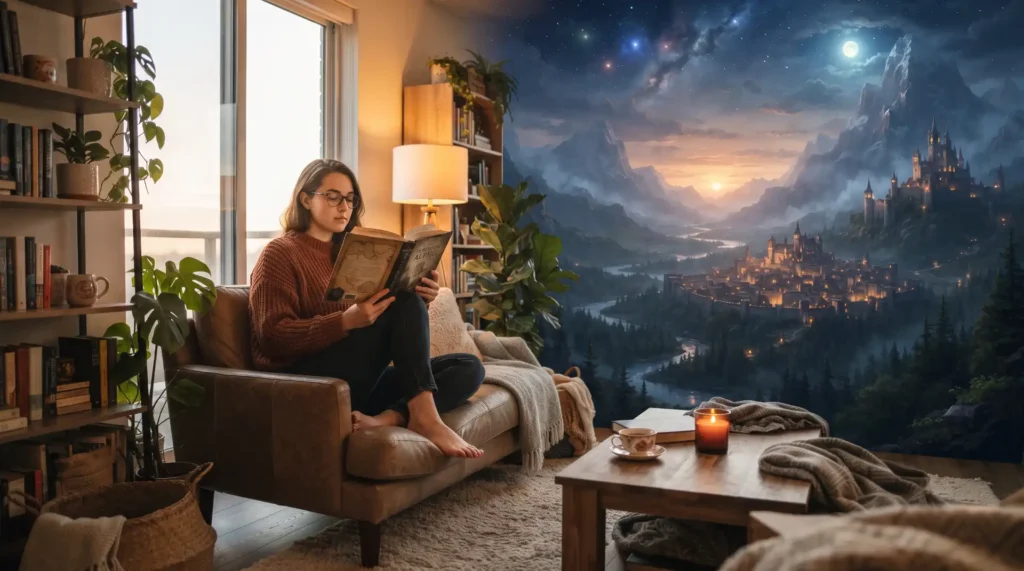
There has always been something powerful about opening a novel and temporarily stepping outside ordinary life. A few pages can move a reader from a crowded apartment or suburban living room into an enchanted forest, an impossible city, a distant planet, a magical academy, a quiet village populated by witches, or a kingdom where dragons still shape the course of history.
In 2026, that ability to go somewhere else has become one of fiction’s biggest attractions.
Across the United States, readers are embracing fantasy, science fiction, romantasy, cozy fantasy, horror, manga, speculative fiction and other imaginative genres that offer experiences far removed from everyday routines. Even books that are not traditionally marketed as fantasy increasingly use heightened atmospheres, alternate histories, mythology, supernatural elements or unusual worlds to create a stronger sense of immersion.
This is more than a handful of viral titles dominating social media. Publishing-industry data suggests that escapist reading has become a meaningful market force. Circana’s analysis of the U.S. book market in the first quarter of 2026 found that escapist and speculative categories including science fiction, horror and manga were performing strongly. Manga alone recorded a 45% increase in print unit sales during the quarter.
Publishers and booksellers are paying attention because readers clearly are.
But the attraction of escapist fiction raises a larger question: Why do so many Americans want to spend their reading time somewhere other than the real world?
The answer has less to do with avoiding reality than it might initially appear.
For many readers, fictional worlds provide rest, emotional distance, imagination, community and even new ways of thinking about real problems. Escapist fiction allows people to step away from ordinary pressures without completely disconnecting from meaningful ideas.
And in an era of constant notifications, economic uncertainty, rapidly changing technology and seemingly endless information, another world can feel remarkably inviting.
Escapist Fiction Is No Longer a Niche Category
Fantasy once occupied a fairly distinct corner of American publishing.
Dedicated fans knew exactly where to find it, but mainstream literary culture frequently treated dragons, magical kingdoms, supernatural quests and invented worlds as specialized interests.
That division has weakened considerably.
Fantasy elements now appear everywhere.
They blend with romance in romantasy. They appear in murder mysteries, historical novels, horror, literary fiction and comedy. Some contemporary novels incorporate mythology or magical realism without fitting neatly into traditional fantasy categories at all.
Readers also appear increasingly comfortable crossing genre boundaries.
Someone who primarily reads romance may pick up a fantasy novel because it contains a central love story. A mystery reader might try a supernatural detective story. A historical-fiction fan may be intrigued by an alternate version of the past. A literary reader might become interested in speculative fiction that explores identity or memory through an impossible premise.
The result is a much larger potential audience for imaginative storytelling.
That shift is visible in the publishing business as well. At the 2026 Bologna Children’s Book Fair, agents and rights professionals told Publishers Weekly that fantasy, romantasy, dystopia, cozy fantasy and speculative fiction remained important areas of demand. Industry professionals also pointed toward continuing interest in genre hybrids rather than stories that fit rigidly into one category.
Escapism has moved toward the center of popular reading culture.
Americans Are Living in an Age of Constant Information
One reason imaginative fiction may feel particularly appealing in 2026 is the sheer quantity of information competing for attention.
For many people, the day begins with a phone.
News alerts, messages, work notifications, financial headlines, weather warnings, social-media posts, videos and advertisements can all appear before breakfast.
The stream rarely ends.
People may spend the workday moving between email, messaging platforms, documents and video meetings. After work, entertainment often arrives through more screens. Even relaxing can involve endlessly scrolling through information selected by algorithms.
Books offer a different rhythm.
A printed novel does not refresh every few seconds.
There is no notification waiting halfway through a chapter. Nothing automatically starts playing when the reader reaches the bottom of a page.
The experience is finite and controlled.
Escapist fiction strengthens that separation because the content itself also moves the reader away from ordinary surroundings.
Putting down a phone and reading a realistic story about office politics can certainly provide a break. But putting down the phone and entering a kingdom filled with ancient magic creates a far more dramatic transition.
The reader is not simply changing media.
The reader is changing worlds.
That desire connects naturally with Bookzee’s coverage of the growing slow reading movement, which has emphasized the appeal of physical books and screen-free reading as alternatives to digital overload. Many readers are deliberately seeking quieter, more intentional ways to consume stories in 2026.
Escapist fiction offers exactly that opportunity.
Other Worlds Give Readers Emotional Distance
It would be easy to describe escapist fiction as a way of avoiding difficult topics.
Often, the opposite is true.
Fantasy and speculative fiction frequently explore war, inequality, prejudice, environmental destruction, political power, grief, economic systems, authoritarianism, family conflict and social expectations.
The difference is distance.
A novel may explore political corruption through an invented empire rather than a contemporary government.
A story about magical resources might examine questions of environmental exploitation.
A supernatural society divided into rigid classes can raise questions about inequality.
A fantasy conflict involving different species or magical communities can explore prejudice and belonging.
The fictional setting allows readers to confront recognizable ideas without seeing an exact reproduction of current events.
That emotional distance can change how a subject feels.
Instead of arriving with established political positions or personal associations, readers encounter the question through unfamiliar characters and rules.
They may find themselves sympathizing with someone whose situation would initially seem impossible.
The result can be escapism and reflection at the same time.
Readers temporarily leave reality only to discover that the invented world contains questions remarkably similar to those waiting for them at home.
Romantasy Has Turned Escapism Into a Cultural Phenomenon
No discussion of escapist fiction in 2026 would be complete without romantasy.
The combination of romance and fantasy has become one of the most visible forces in commercial publishing because it gives readers two highly immersive experiences at once.
There is a world to discover and a relationship to follow.
The fantasy side might involve magical kingdoms, dragons, ancient curses, secret powers, rival courts, dangerous competitions, mythical creatures or political conflict.
The romance adds longing, attraction, betrayal, emotional vulnerability and relationship tension.
Each element intensifies the other.
A dangerous fantasy conflict feels more personal when readers care deeply about the relationship at its center. The romantic relationship feels more dramatic when it unfolds against life-or-death stakes.
The strongest romantasy series also encourage long-term immersion.
One volume establishes the world. Later books expand its geography, mythology, political systems and character relationships.
By the time readers reach the third or fourth book, they are no longer simply following a plot.
They know the place.
That familiarity creates one of escapist fiction’s greatest pleasures: the feeling of returning somewhere.
The continuing commercial strength of romantasy was visible in 2026 bestseller coverage. Publishers Weekly reported that Sarah A. Parker’s The Ballad of Falling Dragons, part of the Moonfall romantasy series, debuted as the number-one book in the country in late May 2026. The earlier title in the series had first gained momentum through self-publishing and BookTok before being reissued traditionally.
Romantasy is therefore not merely a social-media aesthetic.
It is demonstrating real commercial power.
Cozy Fantasy Offers a Gentler Kind of Escape
Not every reader wants to escape into a world where everyone is constantly fighting for survival.
For some, the ideal fictional destination is considerably quieter.
That desire has helped cozy fantasy emerge as an important part of modern escapist reading.
These stories may feature magic, witches, mythical creatures or invented societies, but their central conflicts tend to be intimate rather than apocalyptic.
A former warrior might open a café.
A witch might run a bakery.
Someone may inherit an unusual bookstore.
A group of strangers might renovate an inn.
Characters could build friendships, fall in love, discover a community or learn how to enjoy a slower life.
The world can still contain danger, but danger does not dominate every page.
The primary fantasy is often not defeating evil.
It is finding somewhere safe enough to stay.
That distinction helps explain why cozy fantasy resonates in a period when many readers already feel surrounded by high-stakes information.
They do not necessarily want the fictional world to increase their stress.
They want it to lower the volume.
The genre also overlaps with the growing popularity of comfort reading more generally. Bookzee’s Top Book Reading Trends in 2026 identifies comfort and escapism as prominent interests, noting continued enthusiasm for cozy fiction, romance, hopeful speculative stories and romantasy.
The attraction is simple but powerful.
Readers want stories that make spending several hours inside them feel good.
The New Escapism Is Frequently Hopeful
For years, dystopian fiction provided one of the most popular ways to leave reality.
The destination, however, was usually worse.
Dystopian novels imagined authoritarian governments, social collapse, environmental disaster, extreme inequality, surveillance and technological control.
Those stories remain relevant. In fact, books dealing with dystopian themes continue to attract attention.
But another form of speculative fiction is growing alongside them.
Hopeful fiction asks readers to imagine futures in which people actually solve problems.
The world may be damaged, but not beyond repair.
Communities cooperate.
Characters rebuild.
Technology can be used responsibly.
Environmental problems can inspire adaptation rather than inevitable collapse.
Friendships and collective action matter.
This does not mean every problem disappears.
Hopeful fiction works best when optimism is earned rather than automatic.
Its appeal comes from allowing readers to imagine that improvement remains possible.
That can itself be an escape.
When public conversations often focus on everything going wrong, a story willing to explore what could go right can feel radical.
Other worlds do not have to be perfect.
Sometimes readers simply want a world where trying still matters.
Worldbuilding Makes Reading Deeply Immersive
Escapist fiction depends heavily on place.
The greatest fictional worlds feel as though they existed long before the protagonist arrived and will continue after the final page.
Authors create that illusion through worldbuilding.
A fantasy setting may have its own geography, political systems, religions, economies, architecture, folklore, languages, food, clothing, social customs and historical conflicts.
Readers gradually learn the rules.
Perhaps magic exists, but using it shortens someone’s life.
Perhaps dragons can only bond with particular people.
Maybe one city is permanently dark.
Perhaps the society’s wealth depends on a substance found only in dangerous territory.
Each new detail makes the fictional world feel more complete.
Readers begin asking questions beyond the immediate plot.
What lies across the ocean?
How did these kingdoms become enemies?
Why is magic forbidden here but celebrated somewhere else?
What happened hundreds of years ago?
That curiosity creates investment.
In realistic fiction, readers already understand many of the basic rules. They know roughly how a modern American city operates.
A fantasy novelist has the opportunity to make almost everything discoverable.
That turns reading into exploration.
Maps, Lore and History Reward Readers Who Want Depth
One reason fantasy inspires particularly intense fandoms is that the main narrative may represent only part of the fictional universe.
Readers can become interested in maps, family histories, myths, timelines and background characters who barely appear in the main story.
A map printed near the beginning of a fantasy novel can generate excitement before readers even reach the first chapter.
They see mountain ranges, oceans, capitals, ruins and borders.
Immediately, questions appear.
Will the characters travel there?
Why are those territories divided?
What exists beyond the marked edge?
Which city is dangerous?
The world invites exploration.
This type of depth can be especially attractive in an era of fragmented digital content.
Instead of jumping from unrelated post to unrelated post, readers spend hours learning one coherent fictional system.
That sustained attention may be one reason immersive fiction pairs so naturally with slow reading.
There is pleasure in knowing that the deeper a reader looks, the more there is to discover.
Book Series Let Readers Stay Longer
Escapism becomes even more powerful when readers do not have to leave after one novel.
Fantasy, science fiction and romantasy frequently lend themselves to series because the author has already created a large world capable of supporting multiple stories.
A standalone novel might provide an enjoyable weekend.
A trilogy can become part of a year.
A long-running series might accompany a reader through an entire stage of life.
Returning to later books provides comfort because much of the world is already familiar.
Readers know the characters.
They remember the political factions.
They understand the magic.
They recognize important locations.
Opening the sequel can feel similar to revisiting a favorite place.
This emotional familiarity should not be underestimated.
Readers may eventually associate a series with where they were when they first encountered it, which friend recommended it, or what period of their life they were experiencing.
The fictional world becomes attached to real memories.
That helps explain why beloved fantasy series generate rereading.
The destination matters even after the reader already knows what happens.
BookTok Makes Imaginary Worlds Easy to Discover
Social media may contribute to digital fatigue, but it also plays a major role in helping readers find books that allow them to escape it.
BookTok is especially influential.
Traditional book reviews usually focus on plot, writing and literary analysis.
BookTok recommendations often sell an experience.
A video might describe a novel using only a handful of familiar signals:
Enemies to lovers.
Found family.
Dragons.
Forbidden magic.
A magical competition.
Dark academia.
A mysterious prince.
An enchanted library.
A cozy witch village.
A morally gray heroine.
Readers immersed in online book culture understand these phrases immediately.
They know what emotional experience is being promised.
This has shifted discovery from “What is this book about?” toward “How will this book make me feel?”
That is particularly effective for escapist fiction because atmosphere matters almost as much as story.
Someone may want a fantasy that feels like winter.
Another reader wants a cozy book for autumn.
Someone else wants a story that resembles a favorite role-playing game.
Bookzee has previously examined how BookTok and social media are reshaping reading choices, including the ability of viral recommendations to elevate new releases and revive older titles.
Escapist fiction benefits enormously from this recommendation culture because readers are not simply promoting a book.
They are inviting others into a world.
Video Games Have Prepared Readers for Complex Fictional Worlds
Books are also influenced by the entertainment surrounding them.
Modern American audiences routinely spend time in large fictional universes through video games.
Open-world games encourage players to explore cities, forests, kingdoms and planets while discovering history, factions, hidden locations and side stories.
Role-playing games introduce character classes, abilities, quests, inventories, leveling systems and detailed lore.
These concepts are increasingly familiar.
As a result, readers may be more comfortable entering novels that contain complicated worldbuilding than previous generations were.
That connection is particularly visible in the growth of LitRPG and game-influenced fiction, where storytelling incorporates mechanics associated with role-playing games.
The crossover between reading and gaming also demonstrates why the rise of escapist fiction should not be analyzed only within publishing.
Audiences are learning how to inhabit fictional worlds across media.
Books simply provide one of the most imaginative versions because the reader’s mind supplies the visuals.
Manga Expands the Definition of Escapist Reading
Manga is another major part of the story.
Circana reported that manga was the strongest category in the total U.S. print book market during the first quarter of 2026, with unit sales increasing by 45%.
That is an extraordinary indicator of reader appetite.
Manga encompasses far more than fantasy, of course. Readers can find romance, sports stories, horror, science fiction, historical narratives, slice-of-life stories, mysteries and comedy.
But many popular series offer precisely the kind of immersive alternative reality associated with escapist reading.
Some introduce elaborate fantasy universes.
Others make ordinary settings feel dramatically different through distinctive characters and storytelling conventions.
The format also provides a bridge between books and visual entertainment.
Anime adaptations may introduce American viewers to stories before they ever pick up the print editions.
Once readers become comfortable with manga, they may become more interested in light novels, Japanese fiction and other translated storytelling.
Escapism is therefore increasingly international.
The alternative worlds Americans want to visit do not all originate in American publishing.
Genre Blending Gives Readers More Ways to Escape
One of the defining characteristics of 2026 fiction is that genre categories are becoming increasingly flexible.
Fantasy does not have to be only fantasy.
It can also be romance.
Or mystery.
Or horror.
Or historical fiction.
Or comedy.
Publishing professionals surveyed during the 2026 Bologna Children’s Book Fair pointed to continuing demand for fantasy hybrids, cozy fantasy, dystopia, speculative fiction and other genre combinations.
This flexibility expands the audience.
Consider a reader who normally dislikes traditional epic fantasy.
A magical murder mystery could still appeal.
A romance reader who would never intentionally select a sword-and-sorcery novel may happily read a romantasy centered around enemies falling in love.
Someone who enjoys historical fiction may embrace a novel that adds folklore and supernatural elements to a recognizable historical period.
Genre blending gives readers permission to enter unfamiliar territory while keeping something they already enjoy.
That is important because modern readers increasingly seem to choose books based on mood rather than strict bookstore categories.
The question is not always “What genre do I read?”
It may be “What experience do I want tonight?”
Horror Can Be Escapist Too
At first glance, horror might seem like the opposite of comfort.
Why escape real-world stress by voluntarily entering a haunted house?
Yet horror also creates distance.
The reader’s fear is controlled.
The monster exists inside the book.
The threatening house can be closed.
The supernatural danger has boundaries that everyday anxiety often lacks.
Horror also transforms vague fear into something concrete.
Instead of worrying about dozens of unpredictable real-world problems, the reader can worry about one ghost, monster, curse or killer.
That can be strangely satisfying.
Circana’s 2026 data specifically includes horror among the speculative and escapist categories performing well in the U.S. market.
Escapism therefore does not always mean feeling comfortable.
Sometimes it means choosing which discomfort to experience.
Physical Books Make Fictional Worlds Feel Tangible
The boom in escapist storytelling also intersects with renewed enthusiasm for physical books.
Fantasy and romance publishers have become especially creative with premium editions.
A hardcover may include elaborate artwork, decorative endpapers, maps, foil details, sprayed page edges, illustrated character art or exclusive bonus chapters.
For fans, these features extend the fictional world beyond the text.
The book becomes an object associated with the universe it contains.
A shelf of matching fantasy hardcovers can operate almost like a collection of artifacts.
This helps explain why physical design has become important even when the same story is available digitally.
A beautiful edition offers something an e-book cannot.
It occupies space.
It can be displayed.
It can be lent to a friend.
It becomes part of a reader’s environment.
Physical books also reinforce the analog appeal Bookzee has documented in its coverage of slow reading. When readers want a break from screens, an elaborately produced fantasy novel offers both visual pleasure and immersive storytelling.
Bookstores Are Selling Experiences, Not Just Genres
Walk into a contemporary independent bookstore and recommendations increasingly reflect moods.
Staff displays might feature “cozy reads,” “books for rainy weekends,” “romantasy favorites,” “strange little worlds,” or “books to disappear into.”
That language is significant.
The store is not merely organizing inventory.
It is selling reading experiences.
Someone may not know whether a particular book technically qualifies as fantasy, speculative fiction or magical realism.
They only know they want something immersive.
Booksellers can guide them accordingly.
Industry reporting supports the broader demand. Publishers Weekly noted in early 2026 that dark romance and other escapist fiction had helped support fiction sales, while Circana expected readers to continue exploring genre mashups, science fiction and graphic novels.
For publishers and bookstores, understanding the emotion behind a purchase can be as important as understanding the genre.
Escapist Fiction Creates Communities
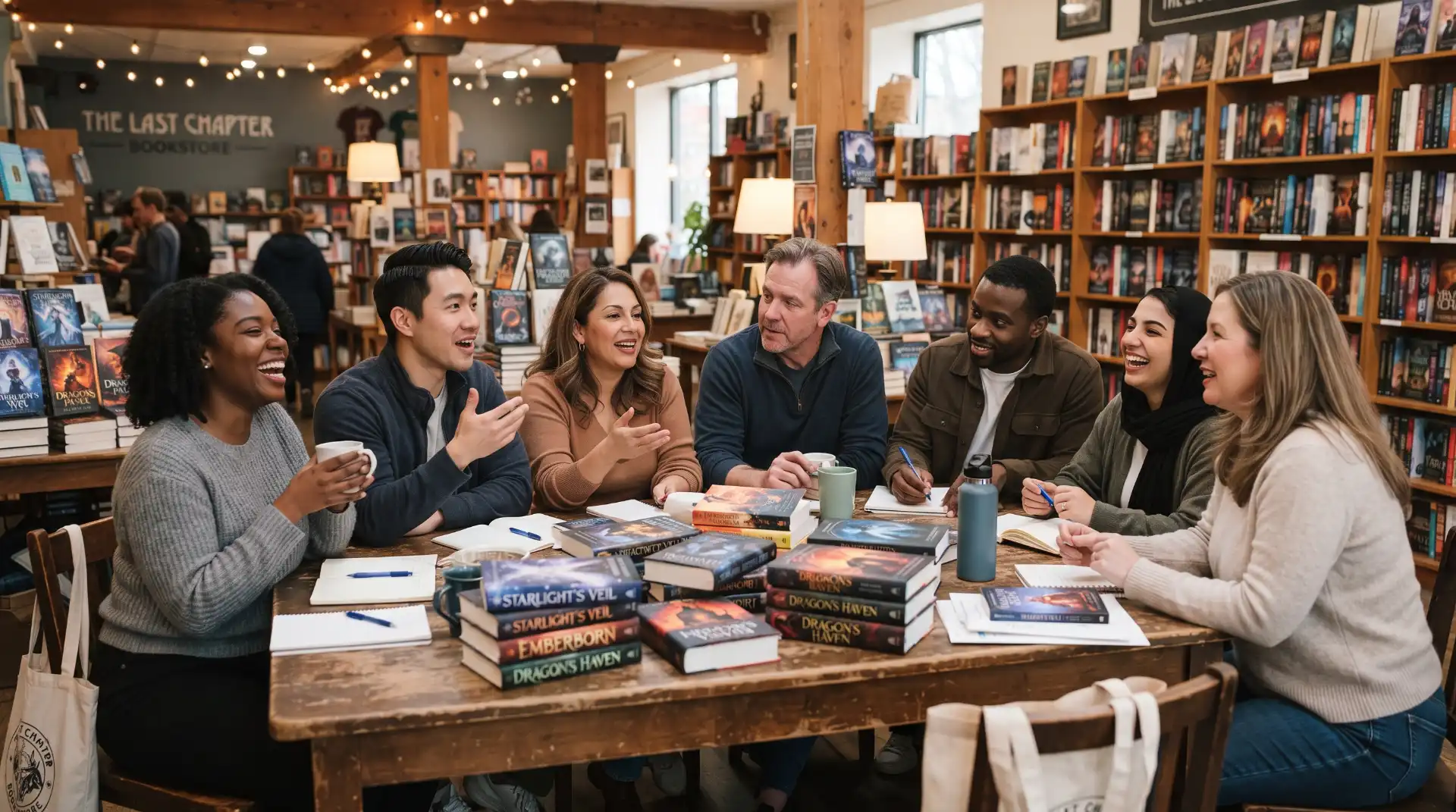
Reading may occur alone, but modern fandom rarely stays solitary.
Popular fantasy worlds generate communities.
Readers discuss theories.
They rank characters.
They debate romantic pairings.
They share fan art.
They create playlists.
They organize themed reading nights.
They attend conventions.
They reread earlier books before a sequel arrives.
Some even travel specifically to locations associated with a favorite author or adaptation.
This social dimension makes escapism more durable.
A reader can close the book without fully leaving the world because conversations about it continue online.
The fictional place becomes shared territory.
Friendships can form around enthusiasm for characters who do not technically exist.
That may sound strange until we recognize that storytelling has always created communities.
The difference in 2026 is scale.
A reader in Ohio can finish a fantasy novel at midnight and immediately discuss the ending with fans in California, Florida, New York or another country.
The imaginary world becomes a meeting place.
Adults No Longer Feel They Have to Outgrow Fantasy
Another major change is generational.
Many American adults who grew up reading fantasy never stopped.
Readers who discovered magical worlds as children moved into young adult fantasy and eventually adult fantasy, science fiction, romantasy and speculative fiction.
They did not necessarily abandon dragons when they acquired jobs, mortgages or families.
The industry grew with them.
Adult fantasy can explore complex politics, sexuality, grief, power, parenthood, morality and identity without losing the imaginative elements that attracted readers when they were younger.
Meanwhile, adaptations and social media continue introducing genre fiction to adults who may not have considered themselves fantasy readers previously.
The old distinction between “serious adult literature” and “imaginative genre stories” has become far less meaningful for many consumers.
People read what they enjoy.
Sometimes that is literary realism.
Sometimes it is a 700-page novel about dragons.
There is room for both.
Audiobooks Make Imaginary Worlds Even More Accessible
Escapist fiction is also benefiting from the continued popularity of audiobooks.
Fantasy novels often contain large casts, distinctive characters and dramatic scenes that lend themselves well to narration.
Some productions go further with multiple voice actors, music or cinematic sound design.
For listeners, this can make fictional worlds feel remarkably immediate.
Audiobooks also allow readers to remain immersed while commuting, exercising, cooking or doing household tasks.
A fictional world no longer has to stay on the bedside table.
It can accompany someone through ordinary life.
That combination may strengthen the appeal of long series.
A 20-hour fantasy audiobook feels far more manageable when listeners can experience it during activities they would be doing anyway.
Escapism Does Not Mean Readers Are Ignoring Reality
The popularity of escapist fiction occasionally produces criticism.
If people are reading about imaginary kingdoms while serious problems exist in the real world, are they avoiding responsibility?
That argument assumes attention must always be productive.
Human beings need rest.
Watching a comedy does not mean someone is unaware of world events.
Listening to music is not an act of denial.
Reading fantasy is no different.
Leisure does not require justification.
But escapist fiction often goes further than simple relaxation.
Stories can help readers process fear indirectly.
They can demonstrate courage.
They can imagine different political systems.
They can challenge ideas about power.
They can explore community.
They can ask what people owe one another.
They can remind readers that societies are constructed and therefore capable of changing.
Sometimes imaginary worlds are useful precisely because they are not ours.
Distance gives readers room to think.
Publishers Are Following the Audience
Publishing companies increasingly recognize that readers are actively searching for immersive experiences.
This affects what books are acquired, how they are packaged and how they are marketed.
Fantasy-inspired visual design appears across social media.
Special editions encourage collecting.
Series create long-term audience relationships.
Self-published success can lead to traditional publishing deals.
Fan communities can influence acquisition decisions.
BookTok engagement can transform an older title into a bestseller years after publication.
Publishing professionals are increasingly watching those signals.
At the 2026 U.S. Book Show, industry figures discussed the growing pipeline from self-publishing and fan-fiction platforms, particularly in romance and romantasy. One publishing-related trend highlighted at the event was the industry’s effort to tap into existing fandoms with measurable engagement.
That reflects an important change.
Readers are no longer waiting for publishers to tell them which worlds deserve attention.
Communities can create demand first.
Publishers may follow.
Why Escapism Feels Especially Powerful in 2026
No single factor explains the rise of escapist fiction.
Instead, several trends are converging.
Americans are dealing with digital fatigue while simultaneously using social media to discover books.
Fantasy has become mainstream.
Romantasy combines two highly emotional genres.
Cozy fantasy offers low-stress alternatives.
Manga introduces readers to enormous imaginative universes.
Video games have normalized detailed worldbuilding.
Audiobooks make long stories easier to experience.
Physical books are increasingly valued as collectible objects.
Online fandoms transform solitary reading into shared culture.
Genre blending gives readers more ways to enter speculative storytelling.
Taken together, these developments create unusually favorable conditions for fiction that promises somewhere else to go.
Circana’s 2026 market findings provide perhaps the clearest confirmation. Even amid pressure on discretionary consumer spending, the company identified escapist and speculative fiction as areas of strength in adult publishing.
Readers may be watching their budgets.
But many are still willing to spend money on stories capable of transporting them.
What the Next Generation of Escapist Fiction May Look Like
The next phase will probably become even more diverse.
Epic fantasy and romantasy are unlikely to disappear, but they will increasingly share attention with less traditional worlds.
Expect more fantasy inspired by folklore outside Western European traditions.
More genre combinations are likely.
Science fiction may increasingly intersect with romance, mystery and horror.
Cozy storytelling may expand beyond medieval-inspired fantasy settings.
Game-influenced fiction and LitRPG may continue moving toward mainstream audiences.
Translated speculative fiction may introduce U.S. readers to storytelling traditions they rarely encountered before.
Readers may also begin resisting overly familiar formulas.
Once every magical café begins to look the same, something new will inevitably replace it.
That cycle is healthy.
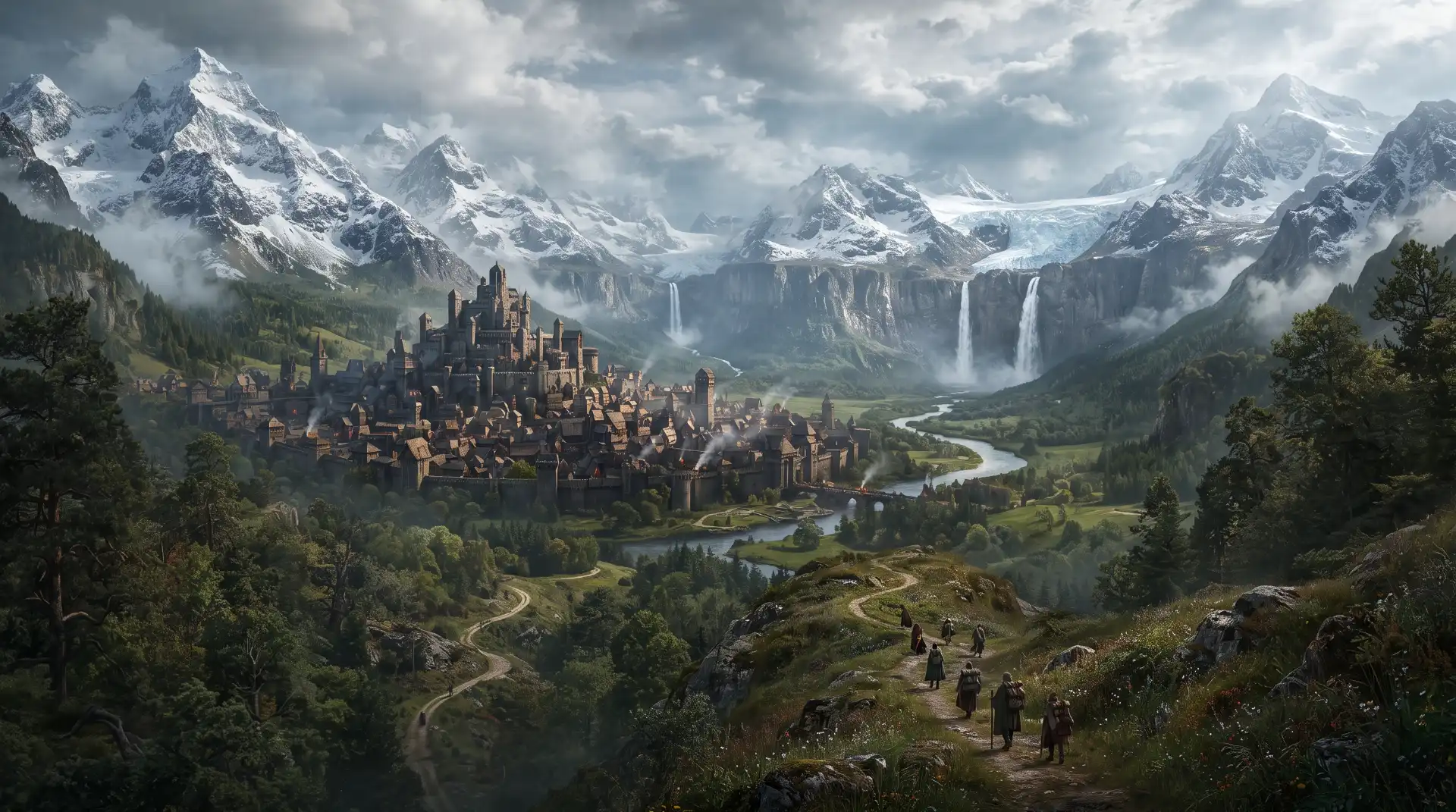
Escapist fiction succeeds because imagination has no fixed destination.
The whole point is that the next world can be different.
The Real Power of Going Somewhere Else
When readers say they want to escape, they are not necessarily saying they dislike reality.
They may simply want a temporary alternative.
For several hours, work emails disappear.
The news feed stops moving.
The bills stay on the table.
Ordinary rules are suspended.
Instead, there may be dragons overhead.
A spaceship may be approaching an unknown planet.
A witch may be opening a bakery.
Two enemies may be realizing they are in love.
An ancient library may contain impossible books.
A kingdom may be waiting to be saved.
The reader knows none of it is real.
That does not make the experience meaningless.
Fiction allows people to rehearse emotions without consequences, encounter unfamiliar ideas without traveling anywhere and experience wonder inside an ordinary afternoon.
Then the final page arrives.
The imaginary world closes.
The reader returns.
But good escapist fiction rarely leaves someone exactly where it found them.
A character may remain memorable.
An idea may follow the reader into the next day.
A fictional friendship may change how real relationships are understood.
An imagined society may make familiar institutions look different.
Or perhaps the reader simply feels rested.
That is enough.
Final Thoughts
The rise of escapist fiction in 2026 reflects something both modern and timeless.
The modern part is visible in BookTok algorithms, deluxe hardcovers, audiobook performances, manga growth, online fandoms, genre mashups and publishing strategies built around highly engaged reader communities.
The timeless part is simpler.
People like stories that take them somewhere.
Long before smartphones, streaming services or bestseller algorithms existed, readers opened books because they wanted to experience lives and places beyond their own.
That instinct has not disappeared.
If anything, an increasingly connected world may have made it stronger.
American readers in 2026 have almost unlimited access to reality. News, commentary, video and information are available every hour of every day.
What can feel scarce is the opportunity to focus completely on something else.
Escapist fiction provides that opportunity.
It offers a door.
On one side is ordinary life.
On the other could be a magical kingdom, peaceful village, haunted mansion, distant galaxy, alternative history, mythical Japan-inspired realm, supernatural bookstore or world no reader has encountered before.
Opening the book is all it takes to cross over.
And as the publishing trends of 2026 continue to demonstrate, millions of readers are more than ready to make the journey.