
Throughout human history, people have developed extraordinary ways to communicate information. Some messages were carved into stone, others were written on parchment, and many were carefully concealed through symbols, substitutions, mathematical patterns, and unfamiliar writing systems. While countless ancient inscriptions have been translated and studied, several mysterious texts continue to challenge historians, linguists, mathematicians, archaeologists, and cryptographers.
The world’s most mysterious unsolved codes occupy a fascinating position between history and scientific investigation. They offer evidence of civilizations, intellectual traditions, political systems, religious practices, and everyday activities that may otherwise be poorly documented. Yet the meaning of these records remains uncertain because the people who created them left behind limited explanations, the languages disappeared, or the writing systems were never successfully understood.
For modern readers, these mysteries provide an opportunity to explore much more than puzzles. They reveal how human communication developed, how information was protected, and how knowledge can become inaccessible when communities disappear or cultural traditions are interrupted.
Books about cryptography, ancient scripts, and lost languages make these subjects accessible to readers without requiring advanced mathematical or linguistic training. A well-researched book can explain how scholars identify patterns in unfamiliar writing, why certain historical inscriptions remain undeciphered, and how a seemingly meaningless sequence of symbols can eventually reveal a sophisticated communication system.
Some of the most fascinating examples include the Voynich Manuscript, the Indus script, the Rongorongo writing system of Rapa Nui, and the mysterious markings associated with several ancient civilizations. Each presents a different research challenge. Some may represent genuine writing systems, others may contain encrypted messages, and some remain difficult to classify because researchers cannot establish what their symbols were intended to communicate.
The growing interest in these subjects also creates an opportunity for readers to discover an unusual category of nonfiction literature. Instead of focusing exclusively on conventional historical narratives, these books examine the unanswered questions behind humanity’s written records.
Understanding these mysteries requires curiosity, patience, and a willingness to distinguish established historical evidence from attractive but unsupported theories.
Understanding the Difference Between Codes, Ciphers, Scripts, and Lost Languages
Before exploring the world’s most mysterious unsolved codes, it is important to understand that the terms code, cipher, script, and language do not describe exactly the same thing.
They are frequently used interchangeably in popular discussions, but historians and cryptographers make important distinctions between them. Understanding these differences helps readers evaluate claims about ancient manuscripts and recognize why some mysteries are considerably more difficult to solve than others.
What Is a Code?
A code is a system in which words, phrases, or concepts are represented by other symbols, numbers, or expressions according to an established convention.
For example, a military organization might use a particular numerical sequence to represent a location or operational instruction. Someone who does not possess the appropriate codebook may see only an apparently meaningless collection of numbers.
Historical codes were frequently used in diplomacy, military communication, trade, and intelligence activities. They allowed people to transmit information while limiting its accessibility to unauthorized readers.
However, a code does not necessarily conceal the structure of an entire language. It replaces selected meanings with agreed-upon representations.
What Is a Cipher?
A cipher transforms readable information into another form through a specific encryption method.
A simple substitution cipher, for example, replaces each letter with another letter or symbol. If someone knows that every letter has been shifted by three positions in the alphabet, they can reverse the process and recover the original message.
More complicated ciphers use mathematical relationships, changing keys, multiple substitutions, or other operations to make unauthorized decoding difficult.
Cryptography is the broader discipline concerned with protecting information through such techniques. Cryptanalysis involves examining encrypted information to discover the original message without necessarily knowing the encryption method or key.
Ancient texts that resemble ciphers can therefore attract cryptographic attention. However, researchers must first establish whether the text actually contains encrypted language.
What Is an Ancient Script?
A script is a system of written symbols used to represent language or, in some cases, other forms of structured information.
Ancient scripts can include alphabetic systems, syllabic writing, logographic symbols, and combinations of different approaches.
Egyptian hieroglyphs are a familiar example of a historical writing system that was successfully deciphered. Other scripts, including the Indus script, remain unresolved.
A script may be visually unfamiliar without being encrypted. Its symbols might simply represent a language that modern researchers do not know how to read.
What Is a Lost Language?
A lost language is a language that is no longer actively spoken or whose historical development is poorly understood.
Some extinct languages can be reconstructed through inscriptions, related languages, surviving documents, and comparative linguistics. Others remain difficult to identify because researchers have very little material to study.
This distinction is especially important when examining mysterious manuscripts. A text can remain unreadable even when its symbols are clearly visible because researchers do not know which language, grammatical structure, or writing conventions produced it.
The central challenge is determining what kind of information the symbols represent before attempting to translate them.
The Voynich Manuscript: The Book That Has Defeated Generations of Researchers
One of the most famous examples of an undeciphered manuscript.
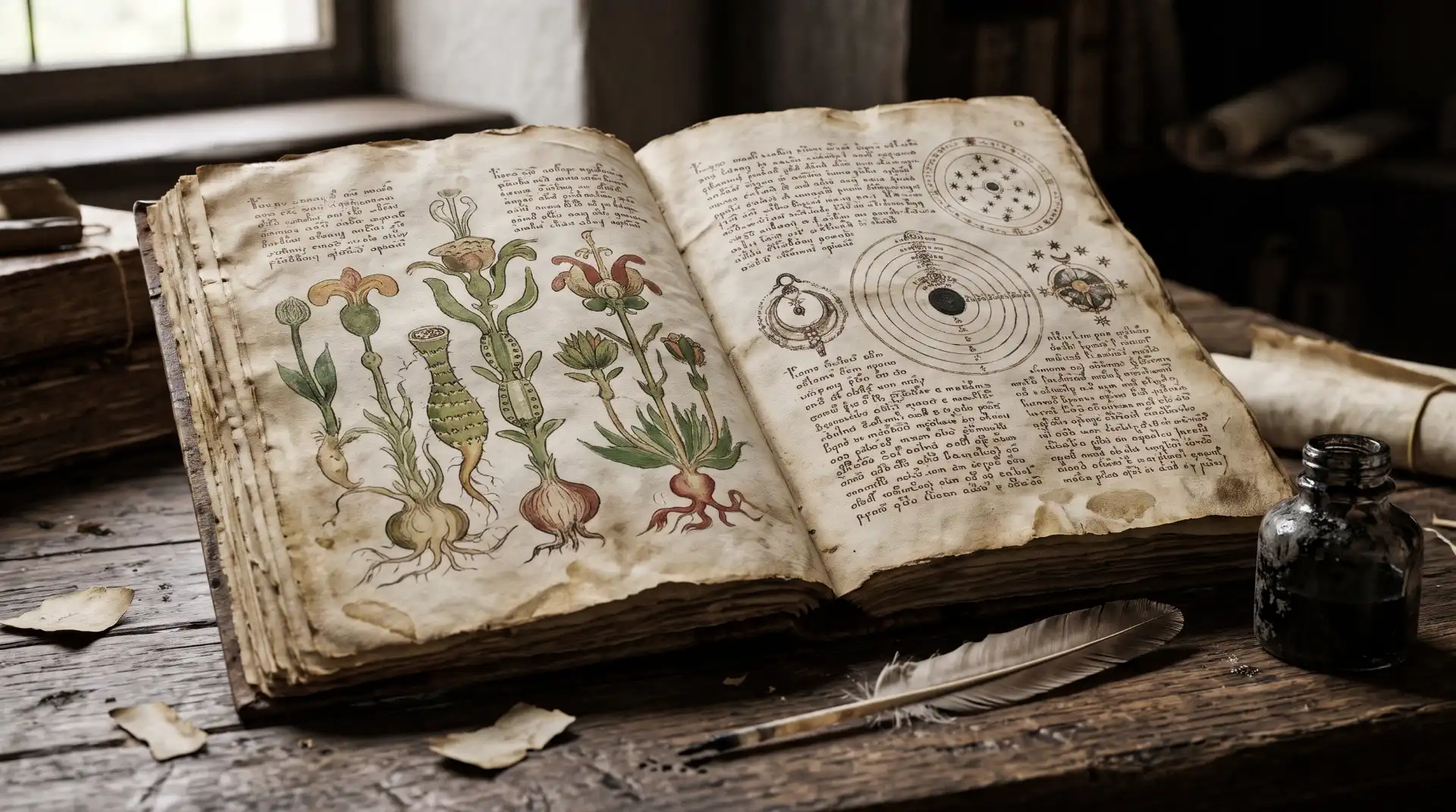
Among the world’s most mysterious books, the Voynich Manuscript occupies an extraordinary position. Its unusual illustrations, unidentified writing system, and uncertain purpose have attracted researchers and enthusiasts for more than a century.
The manuscript is preserved at Yale University’s Beinecke Rare Book & Manuscript Library, where it is cataloged as Beinecke MS 408.
It is generally associated with the fifteenth or early sixteenth century, although scientific examination of its parchment has provided a more specific historical range.
The manuscript became widely known after antiquarian bookseller Wilfrid Voynich acquired it in 1912. Since then, numerous scholars have attempted to identify its language, interpret its illustrations, and determine whether the writing represents an encrypted message or an unfamiliar form of natural language.
Why the Voynich Manuscript Is So Unusual
The manuscript contains hundreds of pages of distinctive writing accompanied by illustrations that appear to depict plants, astronomical observations, bathing scenes, pharmaceutical preparations, and unusual cosmological arrangements.
Its pages contain symbols that do not correspond to any established alphabet in a straightforward way.
The illustrations create an additional puzzle. Some plants resemble recognizable botanical specimens, while others appear to combine unfamiliar characteristics. Astronomical and astrological drawings suggest that at least part of the manuscript may relate to historical systems of knowledge.
Other sections include images of human figures, elaborate circular diagrams, and repeated arrangements of symbols.
The difficulty is that the illustrations do not provide a definitive translation of the text.
Researchers cannot simply identify a plant and assume that the surrounding writing describes its medicinal properties. That interpretation might be plausible, but plausibility is not the same as proof.
Yale’s official Beinecke Cipher Manuscript collection provides detailed historical information and access to high-resolution manuscript images.
Major Theories About Its Meaning
Several broad explanations have been proposed.
One possibility is that the manuscript contains an encoded natural language. Under this interpretation, its unusual writing represents ordinary linguistic information transformed through an encryption process.
Another possibility is that the text represents an otherwise unknown language or writing system.
Some researchers have considered whether the manuscript might contain invented language, specialized technical terminology, or a structured system developed for a particular intellectual or cultural purpose.
There have also been arguments that the manuscript could be an elaborate historical fabrication. However, its complex statistical patterns and physical characteristics make simplistic explanations difficult to establish.
None of these possibilities has produced a generally accepted decipherment.
What Readers Can Learn From Books About the Voynich Manuscript
Books exploring the Voynich Manuscript demonstrate how historical mysteries are investigated through multiple disciplines.
A cryptographer might examine symbol frequency and repetition. A linguist might investigate whether the sequences resemble the grammatical patterns of natural languages. An art historian might compare illustrations with visual traditions from medieval Europe.
A material scientist might study the parchment, pigments, and ink to establish the manuscript’s physical history.
One particularly useful resource is The Voynich Manuscript, edited by Raymond Clemens, with an introduction by Deborah E. Harkness and published by Yale University Press.
The volume includes a facsimile of the manuscript and scholarly discussions of its historical and physical characteristics. It is especially valuable because it allows readers to examine the actual visual evidence instead of relying exclusively on speculative explanations.
For anyone interested in mysterious books, the Voynich Manuscript demonstrates that an object can be historically important even when its words remain unreadable.
The Indus Script: The Unanswered Questions of an Ancient Civilization
The Indus Valley Civilization represents one of the most significant archaeological cultures of the ancient world.
Its major urban settlements included Harappa and Mohenjo-daro, located in regions of present-day Pakistan and northwestern India. Archaeological discoveries reveal sophisticated urban planning, standardized construction practices, extensive trade networks, and distinctive material culture.
Despite these achievements, the writing system associated with the civilization remains undeciphered.
The Indus script is particularly fascinating because its inscriptions appear on a variety of objects, including small seals, pottery, tablets, and other archaeological materials.
Why the Indus Script Is Difficult to Understand
One major challenge is the limited length of surviving inscriptions.
Many examples contain only a small number of signs. This makes it difficult to identify grammatical structures, recurring expressions, and relationships between symbols.
When researchers examine a lengthy manuscript, repeated phrases and sentence structures may reveal clues about the underlying language. Short inscriptions provide far fewer opportunities for this kind of analysis.
Another challenge is the absence of a widely accepted bilingual inscription comparable to the Rosetta Stone.
The Rosetta Stone contained versions of a decree in multiple scripts, including Greek, allowing researchers to connect unfamiliar Egyptian writing with a language they could already understand.
No equivalent discovery has provided a definitive key to the Indus script.
What Might the Symbols Represent?
Researchers have proposed several explanations for the writing system.
Some believe it represents a fully developed writing system used to record a language associated with the Indus civilization.
Others have questioned whether the signs represent conventional writing or a system of symbols used for identification, ownership, religious purposes, or commercial activity.
The debate involves linguistic analysis, archaeology, statistics, and comparisons with other ancient writing traditions.
A major problem is that researchers must avoid assuming that the signs represent a particular language before establishing enough evidence to support that interpretation.
For example, the presence of repeated symbols does not automatically demonstrate that a text contains words or sentences. Symbols can also represent names, titles, objects, administrative categories, or religious concepts.
Why the Indus Script Matters Today
Understanding the Indus script could transform what historians know about one of the ancient world’s major civilizations.
It might provide information about political organization, religious practices, economic relationships, social identities, and the everyday lives of people living in its cities.
It could also help researchers understand how the civilization interacted with neighboring societies.
For American readers, the subject provides an excellent introduction to the relationship between archaeology and linguistics. It shows that discovering an ancient object is only the first step in reconstructing the civilization that produced it.
Books exploring the Indus civilization are particularly valuable when they combine archaeological evidence with careful explanations of the unresolved writing system.
Readers should look for works that distinguish established archaeological findings from competing linguistic interpretations rather than presenting a single speculative theory as a confirmed translation.
Rongorongo: The Mysterious Writing System of Rapa Nui
A historical writing tradition with an exceptionally limited surviving record.
Rapa Nui, widely known in the United States as Easter Island, is famous for its monumental stone statues and distinctive Polynesian cultural heritage.
However, the island also preserves a remarkable writing mystery known as Rongorongo.
Rongorongo consists of inscriptions carved into wooden objects using distinctive symbols. The signs include representations resembling human figures, animals, plants, tools, and other recognizable forms.
The writing system remains undeciphered by scholars, and important questions remain about its development, structure, and relationship to the island’s historical traditions.
The Importance of the Wooden Tablets
Unlike the Voynich Manuscript, which survives as a substantial illustrated book, Rongorongo is represented by a very limited collection of inscribed objects.
The surviving tablets are distributed among museums and collections around the world.
This creates substantial difficulties for researchers because the original cultural environment in which the writing developed has changed dramatically.
During the nineteenth century, Rapa Nui experienced devastating population losses, epidemics, slave raids, missionary influence, and disruptions to the transmission of traditional knowledge.
These historical events affected the communities and cultural practices through which knowledge about the inscriptions might have been preserved.
The loss of cultural continuity makes the investigation especially sensitive. It is not simply an intellectual puzzle involving unfamiliar symbols; it is also connected to the history and heritage of the Rapa Nui people.
Why Researchers Have Not Fully Deciphered Rongorongo
One difficulty is the small number of surviving inscriptions.
Researchers have limited material for comparing repeated signs, identifying vocabulary, and reconstructing grammatical structures.
Another challenge is uncertainty about the nature of the writing system itself.
Although its inscriptions appear highly organized, scholars continue to examine whether it represents a complete writing system, a specialized symbolic tradition, or another form of structured communication.
Some researchers have investigated possible relationships between the inscriptions and traditional Polynesian knowledge, including astronomical observations and lunar calendars.
However, proposed interpretations require careful examination and should not be treated as definitive translations.
The Australian Museum’s Kōhau Roŋoroŋo collection and research resource provides useful context about the tablets, their cultural significance, and the historical disruptions that affected the transmission of knowledge.
Books That Explore Rongorongo and Indigenous Knowledge
Readers interested in Rongorongo should seek books that combine archaeological research, Polynesian history, linguistic investigation, and cultural perspectives.
The best publications recognize that the inscriptions belong to a living cultural heritage rather than treating them exclusively as mysterious artifacts.
They should also explain the difference between scholarly hypotheses and knowledge preserved through Rapa Nui oral traditions.
This distinction is important because a writing system can remain undeciphered by academic researchers even when aspects of its cultural meaning have been preserved within a community.
Rongorongo therefore provides a powerful example of why historical research must consider both physical evidence and the people whose heritage is being studied.
The Phaistos Disc: An Ancient Object Covered in Unexplained Symbols
The Phaistos Disc is another famous archaeological mystery.
Discovered in 1908 at the Minoan archaeological site of Phaistos on the island of Crete, the clay disc contains symbols arranged in a spiral pattern on both sides.
The symbols were impressed into the clay using individual stamps, creating a distinctive appearance unlike most other known ancient inscriptions.
Its unusual manufacturing method has attracted considerable interest from archaeologists, historians, and researchers studying early writing systems.
What Makes the Disc Different?
The Phaistos Disc is unusual because its symbols appear to have been stamped into the clay rather than individually carved or written.
The signs include human figures, animals, plants, objects, and other recognizable forms.
Their arrangement suggests a deliberate system, but the underlying language and meaning remain unknown.
Researchers have proposed several interpretations, including the possibility that the disc contains a religious text, administrative information, a ritual formula, or another structured message.
However, the evidence is insufficient to establish a generally accepted translation.
The Problem of Limited Evidence
The greatest difficulty is that researchers have only one known example of the object.
Without additional inscriptions using the same signs, it is difficult to establish which symbols represent sounds, words, concepts, or other information.
Imagine discovering a single page from an unknown civilization containing a series of unfamiliar symbols. Even if the symbols appear organized, there may be no way to determine whether they represent a prayer, a list of names, a historical account, or an administrative record.
The Phaistos Disc presents a similar problem.
Its uniqueness makes it visually fascinating but scientifically difficult to interpret.
For readers interested in ancient Mediterranean history, books about Minoan civilization provide useful background. They explain the archaeological context in which the disc was discovered and introduce other forms of Aegean writing.
Linear A: The Unreadable Writing System of the Minoans
Another major mystery from ancient Crete is Linear A.
Linear A was used by the Minoan civilization during the Bronze Age and appears on various archaeological objects, including tablets and inscriptions.
Unlike Linear B, which was successfully deciphered, Linear A remains largely unreadable.
Why Linear A Is Important
The successful decipherment of Linear B provided researchers with access to a substantial body of information about the Mycenaean Greek-speaking world.
However, Linear A appears to represent a different language.
Although some signs in Linear A resemble signs used in Linear B, visual similarities do not automatically establish that the underlying language was the same.
Researchers have used comparisons between the two systems to identify possible sound values for certain symbols. Nevertheless, these comparisons have not produced a complete and accepted reading of Linear A.
What Might Be Hidden in Linear A Texts?
The surviving inscriptions appear in several contexts, including administrative records and religious objects.
Some may relate to economic activities, offerings, ownership, or other organized aspects of Minoan society.
If researchers eventually decipher Linear A, it could provide a much deeper understanding of Minoan language, religious beliefs, administration, and cultural identity.
For readers, the comparison between Linear A and Linear B is especially instructive.
It demonstrates how decipherment can become possible when researchers discover related writing systems, bilingual texts, or other reliable sources of comparison.
It also shows that recognizing individual symbols is not necessarily the same as understanding the language in which they were used.
The Rohonc Codex: A Mysterious Book With an Unknown Writing System
The Rohonc Codex is another historical manuscript that has generated considerable debate.
The manuscript is associated with Hungary and is preserved in the collections of the Hungarian Academy of Sciences.
It contains hundreds of pages filled with unfamiliar symbols and illustrations depicting religious, military, and other historical-looking scenes.
The manuscript’s origin, language, and purpose have remained subjects of disagreement.
A Book Filled With Unfamiliar Characters
The Rohonc Codex contains a large number of distinct signs arranged in lines that resemble written text.
Its illustrations appear to include Christian religious imagery, military scenes, and architectural elements.
These features have encouraged researchers to investigate whether the manuscript represents a religious text, a historical document, an invented writing system, or an encrypted work.
However, no interpretation has achieved universal acceptance.
The difficulty is that the manuscript’s writing does not correspond clearly to an established writing system.
Without a confirmed language or reliable comparison text, researchers must work from the internal patterns of the manuscript itself.
Why It Attracts Cryptographers and Historians
The Rohonc Codex is particularly interesting because its unusual signs invite comparison with substitution ciphers and other forms of encoded communication.
Researchers can examine symbol frequencies, recurring sequences, and the relationship between text and illustrations.
However, statistical similarities alone cannot prove that the manuscript contains encrypted natural language.
An invented writing system, a specialized notation, and a cipher can produce different kinds of patterns.
A successful interpretation must explain the manuscript’s structure consistently rather than translating individual symbols selectively.
Books about mysterious manuscripts are useful for understanding how researchers approach such objects without prematurely accepting dramatic claims.
The Beale Ciphers: America’s Famous Buried Treasure Mystery
Not every unsolved code comes from an ancient civilization.
The Beale Ciphers are among the most famous cryptographic mysteries associated with American history.
The story centers on three encrypted documents that allegedly describe the location of a hidden treasure in Virginia.
According to the popular account, the treasure consisted of gold, silver, and other valuables buried by a group led by a man named Thomas J. Beale during the nineteenth century.
The documents supposedly explain the location of the treasure, its contents, and the identities of the people entitled to receive it.
How the Beale Ciphers Work
The three documents are associated with a book-based cipher system.
In this method, a particular reference text is used as a key.
Numbers in the encrypted message correspond to positions within the reference text. Depending on the cipher’s construction, the first letter of a selected word may reveal part of the original message.
One of the Beale documents was reportedly decoded using the Declaration of Independence as the reference text.
That document describes the supposed contents of the treasure.
The remaining two documents have not been convincingly deciphered.
Why the Story Continues to Fascinate Americans
The Beale Ciphers combine several elements that make a mystery particularly attractive: an alleged buried treasure, an unidentified historical figure, encrypted documents, and a possible connection to a familiar American historical document.
However, the story’s historical authenticity remains disputed.
Researchers have questioned the reliability of the surviving account, the origin of the documents, and whether the treasure ever existed.
The fact that one document can be interpreted using a particular reference text does not establish the authenticity of the entire story.
For readers, the Beale Ciphers offer a practical introduction to book ciphers and historical cryptography.
They also demonstrate why an exciting narrative must be evaluated separately from the evidence supporting it.
The Zodiac Killer’s Cryptograms: When Criminal Investigations Become Cryptographic Puzzles
Modern American criminal history provides another example of mysterious encrypted communication.
The Zodiac Killer case involved a series of murders and communications sent to newspapers and authorities in Northern California during the late 1960s and early 1970s.
Some of the communications included cryptograms containing unusual combinations of letters, symbols, and other characters.
These messages attracted widespread attention because they appeared to challenge investigators and invite public participation.
The Famous Zodiac Ciphers
Several cryptograms were associated with the case.
One of the best-known messages, commonly called the 408 cipher, was solved in 1969 by a couple who independently worked on the message.
Another major cryptogram, known as the 340 cipher, remained unresolved for decades before a team of independent codebreakers announced its solution in December 2020.
The solution demonstrated how modern computing, mathematical analysis, and collaborative investigation can contribute to historical cryptographic research.
Other messages associated with the case remain disputed or unresolved.
What Readers Can Learn From Modern Cryptographic Cases
The Zodiac cryptograms illustrate how encrypted communication can become part of a much larger historical investigation.
Unlike an ancient script, investigators generally have more contextual information about the people, institutions, and historical circumstances surrounding a modern cipher.
They may know the language, approximate date, communication method, and intended audience.
That information can help narrow the range of possible solutions.
However, solving a cryptogram does not necessarily resolve the surrounding historical mystery.
The distinction between deciphering a message and establishing the identity or intentions of its author is essential.
Books about American criminal investigations and cryptography provide an opportunity to explore the relationship between mathematics, journalism, law enforcement, and public fascination with unsolved cases.
How Cryptographers Actually Solve Unsolved Messages
The mysteries discussed above may appear completely different, but researchers frequently rely on related investigative techniques.
Understanding these methods can make books about cryptography and ancient writing systems more rewarding.
Rather than simply guessing what symbols mean, specialists build explanations through evidence, comparisons, and repeated testing.
Frequency Analysis
Frequency analysis is one of the most recognizable techniques in classical cryptography.
In English, certain letters appear more frequently than others. The letter E, for example, is generally more common than Z.
If an encrypted message uses a simple substitution cipher, researchers can count how often each symbol appears and compare the results with expected language patterns.
Repeated symbols may provide additional clues.
For instance, if one symbol appears much more frequently than all others, it could correspond to a common letter in the original language.
However, frequency analysis becomes less reliable when messages are very short, heavily encrypted, or written in an unknown language.
It is also important to remember that an unfamiliar script may not represent English or another modern language.
Pattern Recognition
Researchers also examine recurring groups of symbols.
If the same sequence appears repeatedly, it may represent a word, grammatical ending, personal name, or common expression.
The location of repeated sequences can also provide clues.
For example, if a particular group consistently appears at the beginning of inscriptions, it might represent a title, a date, or another introductory element.
These observations become more valuable when researchers have a large collection of comparable texts.
Comparative Linguistics
Comparative linguistics studies relationships between languages.
If an unknown language shares vocabulary or grammatical structures with known languages, researchers may be able to identify possible connections.
Historical sound changes can provide particularly important clues.
Languages evolve over time, and related languages may preserve recognizable similarities even after centuries of separation.
This method has helped researchers reconstruct aspects of languages that no longer have living native speakers.
However, linguistic comparison must be supported by systematic evidence. A few similar-looking words are not enough to establish a relationship.
Archaeological Context
The physical location of an inscription can be just as important as the symbols themselves.
A message found in a burial chamber may have a different likely purpose from one discovered in a commercial storage facility.
Similarly, inscriptions on trade goods, religious objects, military equipment, or administrative tablets may reflect different social activities.
Researchers therefore examine the archaeological context before proposing translations.
The object itself provides evidence about how the writing was used.
Modern Computational Analysis
Computer technology has transformed the investigation of historical texts.
Researchers can now create digital databases, compare thousands of inscriptions, analyze symbol frequencies, and identify recurring patterns across large collections.
Machine-learning methods can help organize and compare visual material.
Digital imaging also allows specialists to examine inscriptions at different resolutions and identify details that may be difficult to see with the naked eye.
However, computers cannot automatically establish the meaning of an unknown writing system.
A statistical pattern may reveal relationships between symbols without identifying the language or explaining what the text communicates.
Human expertise remains essential for interpreting the results and evaluating historical context.
How Books About Unsolved Codes Help Readers Understand History
Books exploring ancient scripts and cryptography are more than collections of unusual puzzles.
They provide a different way of approaching history.
Traditional historical narratives often begin with established events, recognized political figures, and surviving written accounts.
Books about undeciphered texts focus on the gaps in that knowledge.
They ask what can be established from incomplete evidence and what remains impossible to determine.
They Reveal the Limitations of Historical Records
History depends heavily on the preservation of evidence.
Documents disappear through war, environmental damage, political destruction, and ordinary deterioration.
Some civilizations left behind extensive written records, while others are known primarily through archaeological discoveries.
When writing systems cannot be read, researchers may understand a civilization’s architecture, agriculture, and trade networks without knowing much about its language or internal beliefs.
This limitation is one reason undeciphered scripts remain important to historians.
They Connect Science With the Humanities
Cryptographic research combines mathematical analysis with linguistic investigation and historical interpretation.
A researcher might use statistics to examine symbol frequency, archaeology to establish the date of an object, and linguistics to test whether a proposed translation is plausible.
This interdisciplinary approach makes the subject particularly appealing to readers interested in science and history.
It also demonstrates that major discoveries do not always come from a single academic discipline.
They Encourage Critical Thinking
Unsolved codes attract dramatic theories.
Some books claim that ancient manuscripts contain secret religious knowledge, lost technological inventions, or evidence of forgotten civilizations.
Such possibilities may sound exciting, but readers should distinguish documented findings from speculation.
A credible author explains what researchers know, what evidence supports competing interpretations, and what remains uncertain.
This is especially important when discussing manuscripts that have generated sensational claims over many decades.
Readers who enjoy exploring unusual nonfiction subjects can also use Bookzee’s guide to finding hidden literary gems and lesser-known books to discover titles beyond mainstream historical bestsellers.
The Best Types of Books to Explore Cryptography and Ancient Scripts
Not every book about mysterious codes provides the same kind of information.
Some publications focus on mathematical techniques, while others emphasize archaeology, ancient history, or the biographies of famous codebreakers.
Choosing the right type of book depends on what a reader wants to understand.
Beginner-Friendly Cryptography Books
Readers with limited mathematical experience should begin with books that explain basic encryption techniques through historical examples.
Useful subjects include substitution ciphers, transposition methods, frequency analysis, book ciphers, and the historical development of secure communication.
These books can introduce the fundamental principles without overwhelming readers with advanced mathematics.
A good introductory book should also explain why particular methods succeeded or failed.
Historical examples make abstract concepts easier to understand.
Books About Ancient Writing Systems
Readers interested in archaeology and lost civilizations may prefer books that examine Egyptian hieroglyphs, Mesopotamian cuneiform, Linear A, the Indus script, and other historical writing systems.
These publications should explain how writing developed, how inscriptions were discovered, and what evidence scholars use to reconstruct ancient languages.
They are particularly valuable for understanding the difference between deciphered and undeciphered writing systems.
Books About Famous Unsolved Manuscripts
Some readers are primarily interested in individual mysteries.
The Voynich Manuscript, Rohonc Codex, Phaistos Disc, and Rongorongo tablets offer opportunities to examine specific historical objects in considerable detail.
Facsimile editions are particularly useful because they allow readers to inspect the original visual material.
When choosing a book about a particular manuscript, look for publications that include photographs, historical documentation, and scholarly commentary.
Books About the History of Intelligence and Codebreaking
Cryptography has played an important role in warfare, diplomacy, intelligence gathering, and national security.
Books about codebreaking during major conflicts can explain how mathematical discoveries influenced military decisions and international relations.
For American readers, the history of U.S. cryptologic institutions offers an additional perspective.
These works show that cryptography is not limited to ancient mysteries. It remains essential to modern communications and information security.
How to Evaluate Claims About Unsolved Codes Before Buying a Book
The popularity of mysterious manuscripts creates opportunities for both excellent scholarship and unreliable speculation.
Readers should therefore evaluate the quality of a publication before treating its conclusions as established history.
Look for Reliable Historical Sources
A trustworthy book should identify the manuscripts, inscriptions, and archaeological collections on which its arguments are based.
It should provide dates, collection information, scholarly references, and explanations of the research methods used.
When an author discusses a historical object, readers should be able to determine where the object is preserved and whether the claims can be checked against institutional records.
For example, a book discussing the Voynich Manuscript should acknowledge its preservation at Yale’s Beinecke Library and distinguish the manuscript’s documented physical characteristics from theories about its contents.
Be Careful With Claims of Complete Decipherment
One of the most common problems in popular coverage of ancient writing systems is the announcement of a supposedly definitive solution.
A researcher may claim to have translated an entire manuscript or identified the language of an ancient civilization.
However, a successful decipherment must explain the text consistently.
It should account for repeated symbols, grammatical patterns, vocabulary, historical context, and other available evidence.
A proposed translation that explains only selected passages is not enough.
Readers should look for independent evaluation and scholarly discussion before accepting a major discovery.
Prefer Books With Illustrations and Primary Evidence
Historical manuscripts are physical objects, and their appearance can reveal important information.
High-quality images help readers understand the writing style, page layout, material condition, and arrangement of symbols.
Facsimiles are particularly valuable because they allow readers to inspect the evidence without depending entirely on an author’s interpretation.
For serious enthusiasts, books that reproduce original documents are often more useful than publications that rely exclusively on simplified drawings.
Compare Different Scholarly Perspectives
A strong understanding of an unresolved historical mystery requires examining competing interpretations.
One researcher may argue that an inscription represents a writing system, while another may question whether it contains linguistic information at all.
Reading multiple perspectives helps readers understand why a mystery remains unresolved.
It also encourages a more thoughtful approach to historical research.
How American Readers Can Explore Cryptography and Lost Languages
Readers in the United States have access to a wide range of resources for studying historical manuscripts, ancient writing systems, and the development of cryptography.
Public libraries, university collections, museum exhibitions, digital archives, and academic publications make it possible to explore these subjects without traveling internationally.
Use University Digital Collections
Many American universities maintain digitized collections of rare manuscripts and historical documents.
Yale University’s Beinecke Library is particularly relevant because it provides digital access to the Voynich Manuscript.
Digital collections allow readers to inspect original materials, zoom in on individual pages, and compare details across different sections.
These resources are useful for students, independent researchers, writers, and anyone interested in the history of books.
Visit Museums and Historical Libraries
American museums and research institutions frequently organize exhibitions about ancient civilizations, writing systems, historical communication, and rare books.
Visitors can learn how archaeologists preserve inscriptions and how conservators protect fragile manuscripts.
Some institutions also provide lectures, guided discussions, and online educational resources.
These experiences can provide valuable context that is difficult to obtain from reading alone.
Explore Public Library Resources
Local public libraries are excellent starting points for readers interested in cryptography and ancient history.
Many libraries provide access to academic databases, historical encyclopedias, digital newspapers, and specialized nonfiction collections.
University libraries may also offer public lectures and selected digital resources.
Readers should look for books that combine historical research with accessible explanations of scientific methods.
Learn Basic Cryptography
Readers who want to investigate codes themselves can begin with simple substitution and transposition ciphers.
Working through basic exercises helps explain how encryption works and why some methods are vulnerable to statistical analysis.
It also provides a useful foundation for understanding more complicated historical systems.
However, anyone interested in modern cybersecurity should recognize that classical puzzle ciphers are educational exercises rather than secure methods of protecting sensitive information.
Modern information security relies on sophisticated cryptographic systems designed to withstand computational attacks.
The Future of Deciphering Ancient Scripts: Artificial Intelligence and New Research Methods
The investigation of undeciphered writing systems is entering an increasingly technological period.
Artificial intelligence, high-resolution imaging, digital databases, and advanced statistical methods are providing researchers with new ways to study historical inscriptions.
These developments do not guarantee that every ancient mystery will be solved, but they are expanding the tools available to specialists.
Artificial Intelligence and Pattern Recognition
Machine-learning systems can analyze large collections of symbols and identify recurring arrangements.
This can help researchers compare inscriptions, detect similarities, and organize material that would otherwise require extensive manual examination.
For example, a digital system could identify repeated symbol sequences across hundreds of fragments.
Researchers could then investigate whether those sequences appear in similar archaeological contexts.
However, identifying a pattern is not the same as translating it.
An artificial intelligence system may identify statistical relationships without knowing what a symbol means or which historical language produced it.
Digital Preservation of Fragile Manuscripts
Advanced imaging techniques are also helping museums and libraries preserve fragile historical materials.
High-resolution photography, multispectral imaging, and three-dimensional scanning can reveal details that are difficult to observe under ordinary lighting.
These methods may help identify faded writing, erased marks, surface damage, and subtle differences in the physical construction of an object.
Digital preservation also allows scholars around the world to study manuscripts without repeatedly handling delicate originals.
This is particularly valuable for collections containing rare documents that cannot be made available for unrestricted physical examination.
International Collaboration
Many ancient inscriptions are distributed among museums, universities, and private collections across different countries.
Digital databases make it easier for researchers to compare these materials and coordinate investigations.
International collaboration is especially important for writing systems with very limited surviving examples.
By combining inscriptions held in different institutions, researchers may discover patterns that were previously difficult to recognize.
The future of decipherment will likely depend on combining traditional historical expertise with these emerging technologies.
Why the World’s Unsolved Codes Will Continue to Fascinate Readers
There is something uniquely compelling about an old manuscript whose meaning remains unknown.
Unlike a conventional historical document, an undeciphered text invites readers to consider what might be hidden behind its symbols.
It creates a connection between the modern world and people who lived centuries or even thousands of years ago.
The mystery is not simply that researchers cannot read the words. It is that the document may preserve an entire category of human knowledge that modern society has not yet recovered.
The Voynich Manuscript might contain information about historical medicine, astronomy, or another intellectual tradition. The Indus script could reveal important details about an ancient urban civilization. Rongorongo may preserve insights into Rapa Nui’s writing and cultural history. The Phaistos Disc could represent a form of communication that researchers have not yet identified.
Each possibility demonstrates the importance of preserving historical evidence and continuing research.
Books about these subjects also provide something that many readers appreciate: the opportunity to follow an investigation without necessarily reaching a final answer.
A good historical mystery book does not need to promise a sensational discovery. It can be valuable simply because it explains what researchers have learned and why important questions remain unanswered.
For readers who enjoy discovering unusual nonfiction subjects, this category offers an opportunity to move beyond familiar historical narratives and explore the boundaries of human knowledge.
It also demonstrates why the history of communication is so important. Writing allows civilizations to preserve information across generations, but the survival of a document does not guarantee that its meaning will survive with it.
Conclusion: The Search for Lost Knowledge Is Far From Over
The world’s most mysterious unsolved codes represent some of the most fascinating challenges in historical research.
From the illustrated pages of the Voynich Manuscript to the inscriptions of the Indus Valley Civilization, from the wooden Rongorongo tablets of Rapa Nui to the unusual symbols of the Phaistos Disc, these discoveries demonstrate how much of humanity’s written heritage remains difficult to understand.
They also reveal that decipherment is rarely a matter of simply recognizing a few symbols. It requires a combination of linguistic analysis, mathematical reasoning, archaeological evidence, historical research, and careful interpretation.
Books about cryptography, ancient scripts, and lost languages provide an accessible way to explore these subjects. They help readers understand how communication systems developed, why historical messages became inaccessible, and how researchers attempt to reconstruct information from incomplete evidence.
For American readers, these books also offer an opportunity to explore the intersection of science, history, literature, and technology. Whether someone is interested in ancient civilizations, intelligence history, mathematical puzzles, or rare manuscripts, there is an extensive world of nonfiction literature waiting to be discovered.
Perhaps the greatest lesson of these mysteries is that human knowledge is never completely secure. Civilizations disappear, languages become extinct, and written traditions can be interrupted. Yet the surviving objects continue to offer clues about the people who created them.
The next major discovery might come from a newly identified inscription, a previously overlooked manuscript, or an advanced research technique that reveals a pattern hidden for centuries.
Until then, the world’s unsolved codes remain an invitation to investigate, question assumptions, and appreciate how much there is still to learn about the history of human communication.
Discovering Books Beyond the Bestsellers
The subject of cryptography and undeciphered manuscripts also offers an opportunity to explore books that might otherwise remain outside mainstream reading lists. University press publications, specialist history books, illustrated manuscript reproductions, and independently published research can all introduce readers to fascinating historical discoveries.
Readers who want to explore more specialized subjects can use the Bookzee Book Recommendation Tool to discover books that match their interests. Someone fascinated by the Voynich Manuscript, for example, might also enjoy books about medieval medicine, Renaissance science, ancient mathematics, or the history of intelligence.
There is also an interesting connection between this subject and independent publishing. Researchers, historians, and specialist authors sometimes publish niche nonfiction works for audiences that are too small for conventional mass-market publishing. Authors interested in producing their own historical research or educational books can explore Bookzee’s Self-Publishing 101 guide for an introduction to the publishing process.
These connections make mysterious manuscripts an excellent starting point for discovering a much broader world of historical and scientific literature.