
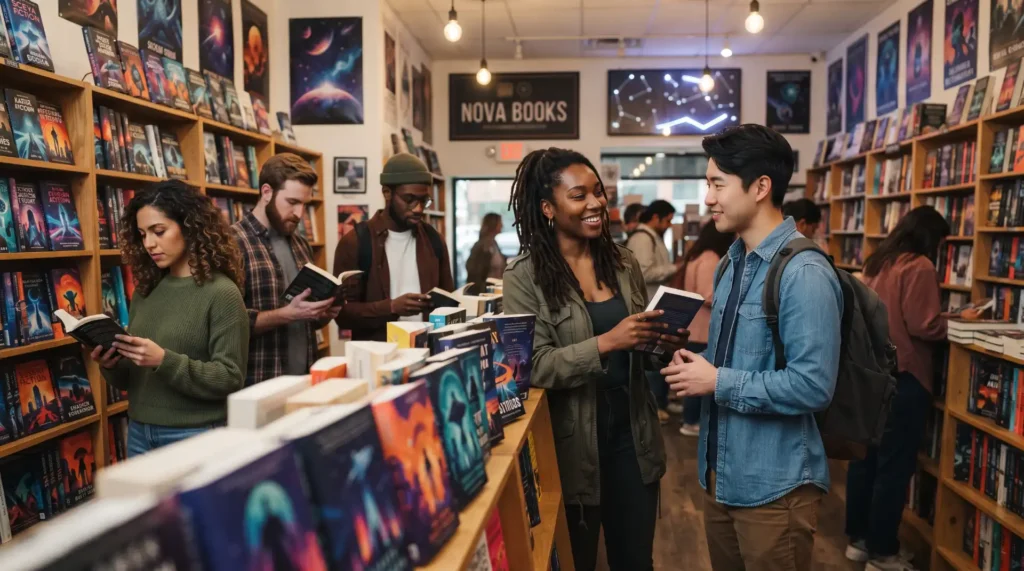
Science fiction once carried a reputation for belonging mainly to devoted genre fans: readers willing to memorize complicated star systems, follow enormous futuristic timelines, or work through novels packed with unfamiliar technology. That version of science fiction still exists, but it is no longer the whole story.
Across the United States, a new generation of readers is discovering that science fiction can be funny, emotional, romantic, frightening, hopeful, political, philosophical, and surprisingly personal.
The genre is also enjoying significant commercial momentum. U.S. publishing data reported by Publishers Weekly showed that science fiction had the largest percentage increase among adult fiction categories in 2025, with print unit sales rising 22.1 percent to more than six million copies. Circana’s 2026 analysis has continued to identify speculative and escapist fiction, including science fiction, as an area of strength in the American book market.
But sales figures tell only part of the story.
Science fiction fits unusually well with the way younger Americans discover entertainment today. Movies introduce audiences to complex fictional universes. Video games make futuristic worlds interactive. Social media turns unusual books into viral recommendations. Podcasts and YouTube encourage conversations about artificial intelligence, space exploration, robotics, climate change, and the future of humanity.
When those readers eventually walk into a bookstore or open a reading app, science fiction no longer seems like an unfamiliar niche.
It often feels like the natural next step.
Science Fiction Feels Closer to Reality Than Ever
One major reason for the renewed interest in science fiction is simple: many subjects that once sounded futuristic are now part of everyday conversation.
Artificial intelligence may be the clearest example.
For decades, science fiction writers imagined intelligent machines, computer-generated personalities, automated societies, robotic workers, and questions about whether technology could imitate or surpass human intelligence.
Those themes once belonged comfortably in the future.
Today, millions of Americans interact with generative AI, recommendation algorithms, automated customer-service systems, smart devices, and increasingly sophisticated digital assistants.
That changes how readers approach science fiction.
A novel about artificial intelligence is no longer necessarily asking, “What might happen hundreds of years from now?”
It may be asking, “What could happen next?”
The same shift applies to space exploration. Private space companies, reusable rockets, renewed interest in lunar missions, satellite networks, and discussions about eventual missions to Mars have made space travel feel less abstract.
Climate change has created another bridge between reality and speculative storytelling. Readers can recognize environmental pressures in stories about drought, extreme heat, resource shortages, disappearing coastlines, migration, renewable energy, or redesigned cities.
Bookzee has already explored this intersection in its article on the rise of climate fiction and eco-horror, where environmental change becomes the foundation for speculative storytelling.
Science fiction works particularly well in this environment because it does not need to predict the future correctly.
Its strength is asking what could happen if current developments continue, accelerate, fail, or take an unexpected direction.
For younger readers who are already thinking about AI, climate, biotechnology, surveillance, automation, and space, those questions can feel extremely relevant.

Today’s Science Fiction Is Much Broader Than Spaceships
Another reason science fiction is attracting new readers is that the genre has become increasingly difficult to define with a single image.
Spaceships, aliens, robots, and distant planets remain important parts of science fiction, but readers can now find stories built around almost any interest.
There is science fiction mixed with romance. Science-fiction mysteries. Climate fiction. Cyberpunk. Solarpunk. Alternate history. Time-travel adventures. Near-future thrillers. First-contact stories. Post-apocalyptic fiction. Cozy science fiction. Military science fiction. Literary speculative fiction.
Some books take place thousands of years in the future.
Others feel almost identical to contemporary America except for one technological change.
That range gives new readers far more ways into the genre.
Someone who loves romance does not have to abandon romance to try science fiction. They can find a futuristic love story.
A mystery reader can follow an investigation on a space station.
A horror fan can discover a terrifying expedition to another planet.
A reader interested in environmental issues can explore a novel about communities adapting to a changing climate.
The boundaries between genres have become increasingly flexible, something Bookzee has also identified in its broader look at top reading trends for 2026.
Genre blending matters because readers rarely think about entertainment as rigidly as bookstore shelves sometimes suggest.
Someone can enjoy a superhero movie, a romance novel, a survival video game, a true-crime podcast, and a fantasy television series during the same week.
Modern science fiction reflects that variety.
Younger Readers Are Comfortable With Complex Fictional Worlds
Previous generations certainly enjoyed elaborate fictional universes. What has changed is how frequently young audiences now encounter them.
Video games ask players to learn fictional histories, political factions, maps, technologies, characters, and rules.
Television franchises unfold across multiple seasons and spinoffs.
Movies connect dozens of characters across shared universes.
Online fandoms examine tiny details, develop theories, create timelines, and debate fictional history.
Anime and manga often introduce American audiences to long-running narratives with large casts and complicated worlds.
That experience prepares readers for one of science fiction’s traditional strengths: world-building.
The unfamiliar planet that once seemed intimidating can instead feel exciting.
A glossary of invented technology is no longer necessarily a barrier. For readers accustomed to learning the mechanics of a new game or understanding the mythology behind a television franchise, discovering how a fictional society operates can be part of the entertainment.
Science fiction rewards curiosity.
Why does this society function differently?
How does this technology work?
What happened before the story began?
What rules govern this world?
Younger audiences have spent years interacting with entertainment that encourages exactly these questions.
Science Fiction Offers Escape Without Ignoring the Real World
Escapism has become an increasingly important part of contemporary fiction.
Readers may want a break from work, school, political arguments, financial pressures, news alerts, and endless notifications.
Science fiction can provide that escape immediately.
A story might transport someone from a New York City subway ride to a planet orbiting another star. A reader in a suburban home can suddenly be exploring an abandoned spacecraft. Someone sitting in an airport can spend the next hour inside a futuristic city.
That sense of distance is valuable.
Yet science fiction has the unusual ability to provide escape while still exploring recognizable real-world concerns.
A novel about another planet may actually be examining inequality.
A story about robots may be asking what kinds of work society values.
A futuristic surveillance system may raise questions about privacy.
An alien-contact story may explore prejudice and communication.
A climate novel may examine how communities respond to disruption.
This combination gives science fiction two functions at the same time.
It takes readers away from the present while giving them another way to think about it.
That is closely connected to the larger popularity of imaginative books explored in Bookzee’s coverage of escapist fiction and readers’ growing desire to visit other worlds.
For readers facing an uncertain future, science fiction creates a safe imaginative space in which that future can be tested.
Science Fiction Has Become More Character-Driven
Readers who avoided older science fiction because they expected pages of technical explanation may be surprised by many contemporary novels.
Technology still matters, but increasingly it exists in service of character.
Readers encounter lonely astronauts, complicated families, reluctant explorers, scientists struggling with impossible decisions, ordinary workers living inside extraordinary systems, and people trying to form relationships under unfamiliar circumstances.
In other words, the emotional questions are often familiar even when the settings are not.
Who can I trust?
Where do I belong?
What am I willing to sacrifice?
Can people change?
What makes a family?
How much control should technology have over our lives?
What does it mean to remain human when the world around us changes?
Those themes do not require a science background.
They require empathy.
That makes contemporary science fiction much more approachable to readers who primarily think of themselves as fans of character-driven fiction.
The futuristic setting becomes the stage rather than the entire point.
Screen Adaptations Create New Readers
Film and television remain powerful gateways into books, and science fiction benefits enormously from this relationship.
When a science-fiction story reaches theaters or streaming platforms, audiences often become curious about the original book.
The effect can be dramatic.
Publishers Weekly reported that Andy Weir’s Project Hail Mary became the second-bestselling print book in the United States during the first half of 2026, with more than 829,000 copies sold during that period, helped substantially by attention surrounding its film adaptation.
This pattern is especially useful for bringing new readers into science fiction.
Someone who does not normally browse the science-fiction section may watch an adaptation and decide to read the novel afterward.
From there, recommendation systems begin doing their work.
Readers who enjoyed one space-survival novel may discover another. Someone interested in a dystopian adaptation may be introduced to near-future fiction. A film featuring artificial intelligence may lead to books exploring similar questions.
One successful adaptation can therefore become the beginning of a much larger reading journey.
Science fiction has another advantage here: it produces stories that translate naturally into visual media.
Futuristic architecture, strange planets, advanced machines, space travel, unusual creatures, and enormous speculative concepts can create memorable cinematic images.
Movies attract viewers to those worlds.
Books allow them to stay longer.
Social Reading Has Made Science Fiction More Discoverable
Book discovery used to depend heavily on bookstores, libraries, newspaper reviews, teachers, and recommendations from friends.
Those sources still matter, but younger Americans now operate inside a much larger discovery network.
TikTok, Instagram, YouTube, Reddit, podcasts, online book clubs, Goodreads-style communities, library apps, digital stores, and creator recommendations can all introduce someone to a book.
This is particularly important for science fiction because the genre contains countless subgenres.
A traditional bookstore may have one large science-fiction section. An online community can create extremely specific recommendations.
Readers can search for hopeful science fiction.
Romantic science fiction.
Science fiction with strong female protagonists.
First-contact stories.
Short science-fiction books.
Science fiction for fantasy readers.
Books about artificial intelligence.
Funny space adventures.
Climate science fiction.
That specificity lowers the barrier to entry.
Instead of asking a new reader to “try science fiction,” online communities can help that person find the exact version of science fiction most likely to match their existing interests.
Bookzee’s article about how BookTok and social media are reshaping what people read looks more closely at how digital communities have changed book discovery.
Recent research on Gen Z reading habits also reinforces how important this broader media ecosystem has become. Researchers Kathi Inman Berens and Rachel Noorda found that Gen Z readers move across print, e-books, audiobooks, online platforms, bookstores, and digital discovery systems rather than treating them as separate worlds. Their 2026 Cambridge University Press study draws on nationally representative U.S. surveys conducted in 2022 and 2025.

Diverse Voices Are Expanding What Science Fiction Can Be
Science fiction has also become more appealing because more writers are bringing different cultural experiences, identities, settings, histories, and traditions into speculative storytelling.
The future no longer has to look like a single cultural vision.
Authors can imagine futuristic versions of American cities, Indigenous communities, immigrant experiences, African societies, Asian megacities, island nations, rural communities, or entirely invented civilizations influenced by cultures that older mainstream science fiction often overlooked.
That variety creates richer worlds.
It also allows more readers to see themselves somewhere inside the genre.
Representation matters particularly in science fiction because the genre is fundamentally concerned with possibility.
If writers are asking what humanity might become, then whose future gets imagined?
Who becomes the scientist?
Who commands the spacecraft?
Who builds the city?
Who survives?
Who falls in love?
Who makes the decisions?
Who gets to imagine a better world?
A wider range of writers produces a wider range of answers.
That has helped science fiction expand beyond some of the stereotypes that once surrounded it and become a genre where different kinds of readers can find stories that speak to them.
Science Fiction Gives Readers a Way to Explore AI Anxiety
Few subjects illustrate science fiction’s modern relevance better than artificial intelligence.
American readers are encountering AI not as a distant hypothetical but as something increasingly present in school, work, entertainment, healthcare, search, customer service, writing, design, and software.
That produces curiosity alongside uncertainty.
What jobs will change?
Can machines create?
Who owns AI-generated work?
How should automated systems make decisions?
Can people trust algorithms?
What happens when people become emotionally attached to artificial personalities?
Who is responsible when an automated system causes harm?
Science fiction gives writers room to explore those questions without pretending to know exactly what will happen.
A fictional AI can exaggerate a real concern.
A future workplace can reveal consequences that today’s technology has not yet produced.
A society built around algorithms can allow readers to examine tradeoffs that are much harder to see in everyday life.
This is one of science fiction’s oldest functions.
The technology changes.
The method does not.
Take something that already exists, push it further, and ask what happens to people.
The Genre Can Be Hopeful Again
For many years, dystopian futures became one of the most visible forms of speculative fiction.
Collapsed societies, oppressive governments, environmental disasters, pandemics, and technological nightmares dominated popular perceptions of the future.
Those stories remain popular, but younger readers are also showing interest in futures that are not entirely hopeless.
That has helped increase attention around solarpunk, hopepunk, optimistic science fiction, and stories centered on rebuilding rather than simply surviving.
These books do not necessarily imagine perfect worlds.
Instead, they ask whether people might solve problems.
Cities might adapt to new environmental realities.
Technology might improve accessibility.
Communities might cooperate.
Scientific discoveries might help rather than destroy.
Humans might encounter something unknown without immediately going to war.
This kind of storytelling is especially interesting for young people who will live through many of the technological and environmental changes currently being debated.
Dystopia asks, “How could everything go wrong?”
Optimistic science fiction can ask, “What would it take for something to go right?”
Both questions matter.
Science Fiction Works Across Every Reading Format
Today’s reader does not have to choose one permanent way to consume books.
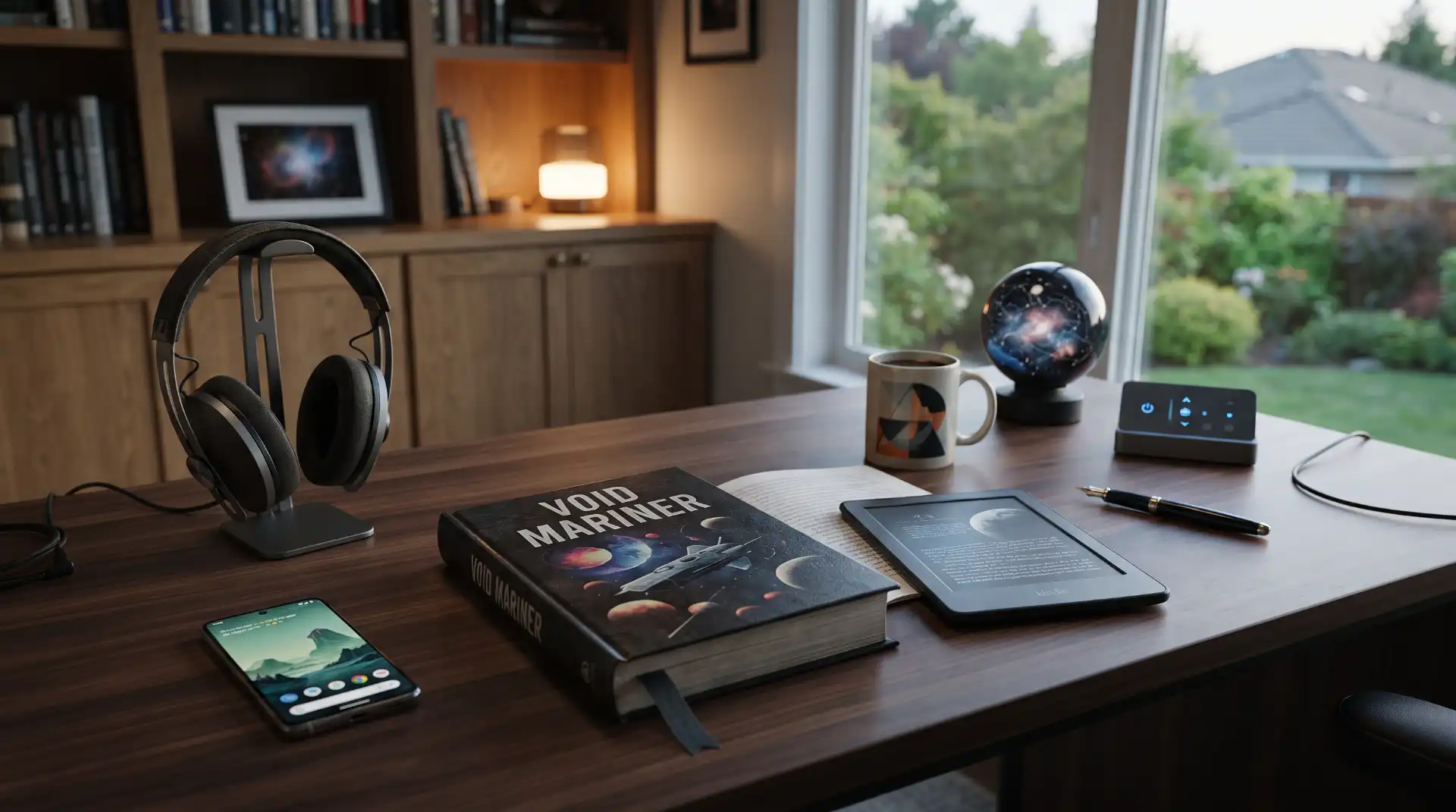
A science-fiction fan may own a hardcover, read another novel on an e-reader, and listen to a third book as an audiobook.
This flexibility is particularly useful for speculative fiction.
A printed edition gives readers time to study maps, glossaries, timelines, and unfamiliar terminology.
An e-book makes a long science-fiction novel easier to carry.
An audiobook can turn a commute into a journey across another galaxy.
Full-cast and immersive audio productions can add different voices and sound design, making speculative worlds feel almost cinematic.
Younger readers are especially comfortable moving among these formats. Recent research into Gen Z reading describes this generation as operating in a multimodal environment where print, digital reading, audio, online platforms, and other forms of media frequently overlap.
That flexibility makes lengthy or complex science-fiction stories less intimidating.
A reader can choose whichever version fits their life.
Science Fiction Connects Naturally With Gaming Culture
Video games may be one of the most underestimated gateways into science-fiction reading.
Many popular games already require players to engage with the fundamental building blocks of speculative fiction.
They explore invented planets.
They interact with artificial intelligence.
They navigate futuristic governments.
They discover fictional technologies.
They make moral decisions about unfamiliar societies.
They read databases, character histories, mission logs, and world-building material.
A player who spends dozens of hours exploring a futuristic game world is already engaging with many of the same pleasures that science-fiction novels provide.
Books simply deliver those pleasures differently.
The connection works in both directions.
A gamer may discover science-fiction novels because they want another complex world to explore. A reader may turn to games because they want to interact with environments similar to those they have imagined on the page.
Rather than competing for attention, different media can reinforce one another.
Libraries and Independent Bookstores Still Matter
It would be easy to assume that younger readers discover everything through algorithms.
The reality is more interesting.
Research published in 2026 on Gen Z’s book habits found significant interaction with physical bookstores and libraries alongside digital discovery. The research describes a generation that may find recommendations online but still values physical books and real-world literary spaces.
That combination benefits science fiction.
A viral recommendation might convince someone to visit a bookstore.
A librarian can then recommend another author.
A science-fiction display can introduce a reader to a subgenre they did not know existed.
A local book club can turn a solitary reading experience into a social one.
The modern reading ecosystem is not simply digital replacing physical.
It is digital leading to physical, physical leading to digital, and both feeding the same curiosity.
Science Fiction Is an Ideal Genre for an Uncertain Era
Every generation inherits questions about its future.
The current generation of young American readers simply has an unusually large number of those questions arriving at the same time.
How will artificial intelligence change work?
What will cities look like in 2050?
Will humans establish permanent settlements beyond Earth?
How will climate change reshape where people live?
What happens when biotechnology becomes more powerful?
Will privacy survive increasingly sophisticated surveillance?
How will relationships change in a world of artificial personalities and virtual environments?
Science fiction does not provide reliable predictions.
That is not its job.
It provides scenarios.
A writer can build one possible future and invite the reader to walk through it.
Sometimes that future is terrifying.
Sometimes it is beautiful.
Often it contains both.
The value lies in thinking through the possibility.
A New Generation Is Redefining the Science Fiction Reader
The growing popularity of science fiction among younger Americans does not mean every new reader is becoming a traditional science-fiction fan.
That may actually be the most important part of the trend.
The definition of a science-fiction reader is expanding.
It can be someone who reads one climate novel a year.
A romance reader who occasionally visits another planet.
A gamer who discovers a space opera.
A BookTok user who sees an intriguing recommendation.
A movie fan who reads the novel behind an adaptation.
A college student fascinated by artificial intelligence.
A commuter listening to a futuristic audiobook.
A longtime fantasy reader looking for a different kind of invented world.
All of them belong in the audience.
Science fiction is succeeding because it increasingly meets readers where they already are.
The Future Is Becoming Personal
Science fiction has always looked ahead, but its current appeal comes partly from how personal the future now feels.
Artificial intelligence is on people’s phones.
Climate questions affect communities across the United States.
Space launches appear in everyday news.
Algorithms influence what people watch, buy, listen to, and read.
Technologies that once belonged to futuristic novels are entering ordinary life.
That makes science fiction more than an escape.
It becomes a way to think.
Young American readers can use these stories to imagine possible careers, possible societies, possible technologies, possible disasters, and possible solutions.
They can experience futures they would never want to live in and futures they wish existed already.
Most importantly, they can ask the question at the heart of nearly every great science-fiction story:
What happens next?
For a generation growing up during rapid technological and cultural change, few questions could be more relevant.