
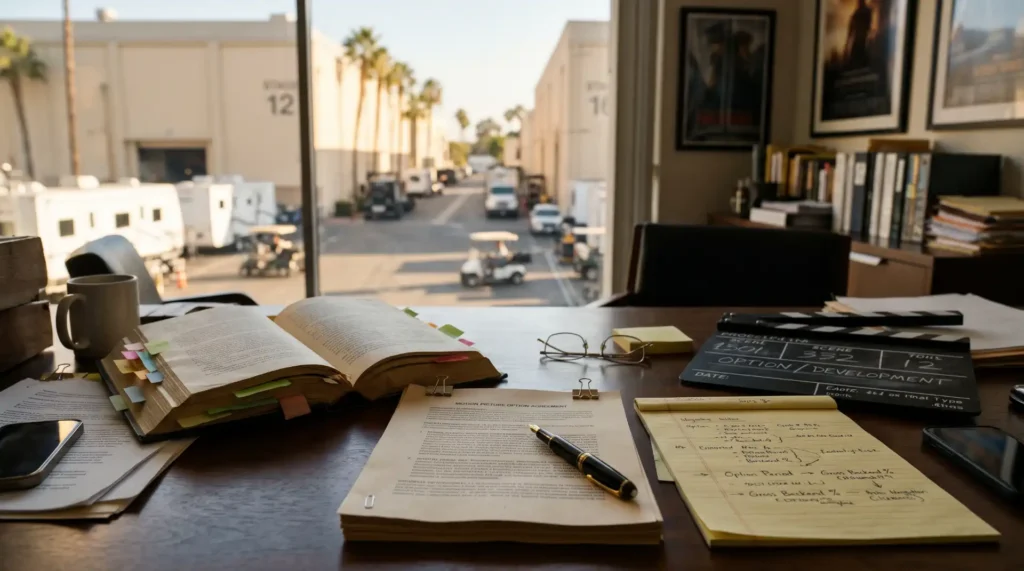
A bestselling book can travel much farther than its original pages. A novel that begins on a bookstore shelf may eventually become a feature film, a television series, a streaming production, or even a franchise with sequels and merchandise. For authors, that possibility is exciting not only because millions of new people may discover their stories, but also because selling film and television rights can create another source of income beyond book sales.
However, the journey from bestseller to Hollywood is not as simple as a movie studio purchasing a book and immediately beginning production. Film and television adaptations involve a separate set of intellectual property rights, legal agreements, negotiations, development periods, and payment structures. A producer may pay an author for the temporary exclusive opportunity to develop a story without ever making a movie. A studio may eventually purchase the adaptation rights, but the author might not receive the same financial benefits from the finished film that readers assume.
Understanding book adaptation rights is therefore important for writers, publishing professionals, literary agents, and readers interested in how the entertainment industry transforms popular books into screen productions.
The financial arrangements can vary considerably. An author whose unpublished manuscript attracts a small independent producer may receive a modest option payment. A well-known novelist with a successful book series may negotiate a much larger agreement involving a guaranteed purchase price, additional payments for sequels, and other contractual protections. A rare, highly competitive property can generate substantial sums, although these outcomes are not typical for most writers.
The most important distinction is between having a book that sells well and having a story that a film or television producer wants to develop. Commercial success can help attract attention, but it does not guarantee an adaptation deal, a large payment, or a finished movie.
This guide explains how Hollywood acquires book rights, how option agreements work, what authors may earn, which rights they should consider retaining, and what writers should examine before signing an adaptation contract.
Why Hollywood Looks to Books for Movie and Television Ideas
Books have long been an important source of material for movies and television. Established novels offer producers something valuable: a developed story with characters, settings, conflicts, themes, and an existing audience. Rather than beginning with an entirely original concept, a filmmaker can explore a narrative that has already demonstrated its ability to attract readers.
That does not mean every bestselling book is suitable for a screen adaptation. A successful novel may depend on an interior monologue, an unusual narrative structure, or a series of subtle observations that are difficult to translate into visual storytelling. A book with relatively modest sales may have a strong cinematic premise, memorable characters, or a setting that a producer believes could appeal to a particular audience.
Producers also look beyond bestseller lists. They may discover books through literary agents, publishers, film-rights representatives, independent scouts, book festivals, online reading communities, and recommendations from actors, directors, or screenwriters. A manuscript can attract interest before publication if a producer believes the premise has commercial or creative potential.
A Book Already Has a Storytelling Foundation
One reason novels are attractive to filmmakers is that they contain an established narrative foundation. A producer considering an adaptation can evaluate the central conflict, character relationships, dramatic turning points, and overall structure before committing to a major production.
For example, imagine a mystery novel about a small-town journalist investigating a decades-old disappearance. The book may have a strong central question, a limited number of important locations, and a series of discoveries that naturally create suspense. A producer could imagine how those elements might work in a feature film or a limited television series.
The adaptation might eventually change the setting, combine characters, remove subplots, or create a different ending. Nevertheless, the original novel provides the starting point.
A recognizable readership can also make the project more attractive. Publishers and producers may already have information about the book’s sales, audience demographics, reviews, media attention, and cultural reach. These details can help a production company decide whether the story has enough potential to justify development expenses.
Bestseller Status Helps, but It Is Not a Guarantee
A book’s commercial performance can strengthen its position in negotiations, especially when several producers are interested in the same property. A title that has sold hundreds of thousands of copies may offer a producer evidence of an established audience. A novel that has become popular through online communities may also attract attention even if its original publication was relatively small.
However, book sales are only one part of the decision.
A studio may be interested in a bestselling novel but decide that its production costs are too high. Another company may prefer a less famous book because it can be adapted into a contained thriller with a manageable budget. A producer may also believe that a particular story is better suited to television than to a two-hour feature film.
The commercial success of a book can open doors, but the strength of the adaptation concept, the availability of rights, the production budget, and the interests of filmmakers all matter.
 What Are Book Adaptation Rights?
Book adaptation rights are the legal permissions needed to turn a written work into a movie, television program, or another audiovisual production. In the United States, these rights are connected to copyright law, which gives copyright owners certain exclusive rights over their original works.
One of those rights is the ability to authorize derivative works. A derivative work is based on an existing copyrighted work and transforms or adapts it into another form. A motion picture based on a novel is a familiar example.
The U.S. Copyright Office explains the relationship between copyright and adaptations in its guidance on copyright in derivative works. Its explanation is important because it shows why a producer generally needs permission from the appropriate rights holder before legally adapting a protected novel.
Copyright and the Right to Authorize an Adaptation
When an author creates an original novel, copyright protection generally arises automatically once the work is fixed in a tangible form, such as a saved manuscript or printed book. Registration with the U.S. Copyright Office is not required for copyright to exist, although registration can provide important legal advantages when enforcing rights.
The author may own the copyright personally, or ownership may have been transferred or assigned through a publishing, work-for-hire, or other agreement. This is why an author should not assume that every adaptation right remains available simply because the author wrote the book.
A traditional publishing contract may grant a publisher certain subsidiary rights or give the publisher the ability to negotiate rights on the author’s behalf. The exact arrangement depends on the contract. Some authors retain film and television rights, while others authorize their literary agent or publisher to handle those opportunities.
Before negotiating with a producer, the author or representative needs to establish who controls the relevant rights.
Film Rights Are Not the Same as Publishing Rights
A publishing contract generally concerns the rights needed to publish and distribute the book in specified formats, territories, and languages. Film and television rights concern a different type of use.
A publisher might have the right to produce hardcover, paperback, and electronic editions without owning the right to make a movie. An author might also retain audiobook, stage, merchandising, or other rights, depending on the publishing agreement.
The distinction matters because a producer interested in adapting a novel may need only certain audiovisual rights. The author should understand exactly which rights are being granted and which remain available for other opportunities.
For example, a writer might agree to license motion picture rights for one feature film while retaining certain stage or publishing rights. Another agreement may cover theatrical films, television productions, streaming programs, remakes, and sequels. These are very different arrangements, even if both are described casually as a sale of the film rights.
A contract should define the rights clearly rather than relying on broad phrases that leave important questions unanswered.
How the Film Option Process Works
One of the most important concepts in book-to-film agreements is the option. In many cases, a producer does not immediately purchase all adaptation rights. Instead, the producer pays for an exclusive period during which the producer has the opportunity to develop the project and decide whether to acquire the rights.
This arrangement gives the production company time to explore the project without paying the full purchase price at the beginning. It also gives the author compensation for temporarily taking the property off the market.
The Authors Guild provides an explanation of the financial and contractual terms commonly found in film and television options. Its model film and television option contract is a useful reference for understanding how option payments and option periods may be structured.
Step One: A Producer Discovers the Book
The process often begins when a producer, production company, studio executive, or representative discovers a book that appears suitable for adaptation.
The discovery might happen before publication, shortly after a book becomes a bestseller, or years after its original release. A literary agent may circulate a manuscript to film and television representatives. A publisher may highlight a title with strong adaptation potential. A producer may independently approach an author after reading the book.
At this stage, the producer is usually evaluating the story rather than committing to make a film. The company may consider whether the material could support a feature-length movie, a limited series, or a continuing television program.
The producer may also investigate whether the adaptation rights are available. If a publisher, estate, co-author, or another party controls the relevant rights, the producer must identify the appropriate person or entity with authority to negotiate.
Step Two: The Parties Negotiate an Option Agreement
If the producer wants exclusive time to develop the project, the parties may negotiate an option agreement.
The agreement typically identifies the work being optioned, the rights covered, the length of the option period, the payment, and the conditions under which the producer can exercise the option and purchase the rights.
An initial option period may last 12 to 18 months, although the length is negotiable. Some agreements allow one or more extensions if the producer pays additional fees. The actual terms depend on the project, the parties’ bargaining positions, and the anticipated development process.
During the option period, the producer may try to attach a screenwriter, director, actor, or production partner. The company may also prepare a pitch, develop a screenplay, approach financiers, or present the project to a studio or streaming service.
The author usually cannot offer the same rights to another producer while a valid exclusive option is in effect. This is why the length of the agreement matters. A writer who grants a long option with weak extension terms may lose the opportunity to negotiate with other interested companies for an extended period.
Step Three: The Producer Develops the Project
An option does not mean a movie is guaranteed. Development can involve months or years of work, and many projects never reach production.
A producer might hire a screenwriter to create an adaptation. The screenwriter may produce an initial draft, followed by revisions requested by the producer, director, studio, or potential cast members. The story may change significantly during this stage.
The company may also try to secure financing, identify a distributor, attach recognizable talent, or persuade a studio to acquire the project. Each step involves uncertainty. A project can lose momentum if a director becomes unavailable, financing falls through, a studio changes its priorities, or the screenplay does not satisfy decision-makers.
This explains why option agreements are common. They allow producers to investigate a project without immediately paying the full price for permanent adaptation rights.
Step Four: The Producer Exercises the Option
If the producer decides to move forward and satisfies the contract’s requirements, the producer can exercise the option. This generally triggers the purchase or acquisition of the agreed adaptation rights.
The author then receives the purchase price specified in the agreement, subject to the payment terms and any applicable credits for earlier option fees.
The precise trigger is extremely important. Some contracts tie the purchase to the start of principal photography. Others use a different defined event, such as a financing or production commitment. The author should not assume that the producer must pay the full purchase price simply because a screenplay has been written or a studio has expressed interest.
The agreement should state exactly when the purchase price becomes due and what happens if production is delayed or never begins.
Step Five: Production and Release
If the project moves into production, the producer and studio will handle the many practical tasks involved in making the film or series. These may include casting, hiring the director, securing locations, preparing sets, filming, editing, marketing, and arranging distribution.
The author may or may not be involved in those decisions. Some contracts provide consultation rights or allow the author to receive production updates. Others give the production company broad creative control.
When the finished film is released, the author may receive contractual payments tied to release, performance, sequels, or other forms of exploitation. However, those benefits are not automatic. They must be negotiated and included in the agreement.
How Much Do Authors Earn From Book Adaptation Rights?
There is no universal Hollywood payment for adapting a book. The amount an author receives depends on the book’s popularity, the producer’s resources, the project’s expected budget, the scope of the rights, competition from other buyers, and the author’s negotiating position.
A relatively unknown novel might receive a small option payment. A book with a large readership and strong industry interest may attract a more valuable offer. A major bestseller with multiple interested studios can create a competitive situation in which the author has considerably more leverage.
It is important to distinguish between the money an author receives for an option and the money received when the adaptation rights are purchased. These are separate stages of a potential deal.
1. The Initial Option Fee
The option fee is the payment a producer makes to secure exclusive rights to pursue the adaptation for a specified period.
The Authors Guild’s guidance on option agreements describes initial payments that can range widely, with typical option fees in the range of a few thousand to tens of thousands of dollars in many deals. Its published discussion notes that fees can vary substantially according to the property and the parties involved. These figures should be treated as industry examples, not guaranteed rates or a fixed price list.
For an author, even a modest option payment can be meaningful. It provides compensation while the producer has exclusive access to the adaptation opportunity. The payment is generally not refundable simply because the producer decides not to make the film.
Consider an author whose mystery novel has attracted attention from a small independent production company. The producer offers $5,000 for an 18-month option. The author receives the agreed payment, but the producer has not purchased the full adaptation rights yet. If the company does not exercise the option, the author may regain the ability to offer those rights elsewhere after the agreement expires.
A more established writer with a popular novel might negotiate a much larger initial fee, especially if multiple production companies are interested. The amount is determined by negotiation rather than by a universal industry formula.
2. Extension Payments
A producer may need additional time to develop a project. An option agreement may therefore include an extension provision that allows the company to keep the rights for another specified period by paying an additional fee.
For example, an author might agree to an initial 18-month option with one 12-month extension. The producer pays $7,500 for the first period and an additional $10,000 to extend it. The exact figures are simply an illustration; real agreements vary.
Extension payments matter because they compensate the author for continuing to keep the property unavailable to other producers. They also create a point at which the production company must decide whether the project is worth pursuing further.
Authors should examine whether the producer has unlimited extension rights, whether extensions require additional payments, and whether the extension fee is credited toward the purchase price. An extension that costs very little may allow a company to hold a valuable property for a long time without making meaningful progress.
3. The Purchase Price
If the producer exercises the option, the purchase price is the amount paid to acquire the agreed adaptation rights.
There are several ways to calculate this payment. Some contracts specify a fixed amount. Others tie the price to the production budget, often with a negotiated minimum and maximum. A percentage-based formula can give an author some participation in the scale of the production, although the details of the budget calculation are critical.
For illustration, suppose a contract provides for a purchase price equal to 2.5% of an approved production budget, subject to a $75,000 minimum and a $300,000 maximum. If the qualifying budget is $8 million, 2.5% would equal $200,000. If the budget is $20 million, the formula would produce $500,000, but the negotiated cap would limit the purchase price to $300,000.
This is only a hypothetical example, not a standard Hollywood rate. The definition of the budget, permitted deductions, cap, floor, and payment trigger all affect the actual amount.
The Authors Guild’s model contract materials are useful for understanding how option and purchase terms are structured. Authors should have an experienced entertainment attorney review the specific agreement rather than assuming that a percentage mentioned in a deal summary will translate directly into a particular payment.
4. Can Authors Earn a Percentage of the Movie’s Profits?
Some authors negotiate additional compensation based on the financial performance of the film or television production. This is often described as backend participation.
However, the phrase “a percentage of the profits” can be misleading. A contract might define participation in net profits, adjusted gross receipts, or another carefully defined revenue category. These terms are not interchangeable.
A net-profit participation may sound attractive, but the calculation can be affected by distribution fees, marketing costs, production expenses, financing charges, overhead, and other contractual deductions. A film can perform well commercially without generating the defined net profits required to trigger a payment.
For this reason, an author should not accept a lower guaranteed purchase price merely because a producer promises a share of future profits without carefully reviewing how those profits will be calculated and reported.
Where possible, an author may negotiate a clearer participation formula, audit rights, reporting obligations, and access to relevant accounting records. A guaranteed payment is generally easier to evaluate than a speculative promise of future profits.
5. Additional Payments for Sequels and Other Uses
A successful film may lead to sequels, prequels, television spin-offs, remakes, or related productions. The original book agreement should address whether the producer has the right to create these additional works and whether the author receives further compensation.
An author whose novel is the first book in a series should pay particular attention to these provisions. A producer may want the right to adapt future installments, use characters across multiple productions, or develop new stories based on the original property.
The author may prefer to negotiate separate payments for each sequel or a defined formula for additional productions. If the contract grants broad rights to use characters, settings, and story elements in future projects, the author should understand the long-term effect before signing.
 What a Book-to-Film Deal Might Look Like in Practice
The following hypothetical examples illustrate why author earnings can differ so dramatically. They are not reports of actual deals or promises of what a writer should expect.
Example One: A Debut Novel Optioned by an Independent Producer
A first-time novelist publishes a contemporary suspense novel through a small press. The book receives positive reviews and attracts a modest but enthusiastic readership. An independent producer believes the story could become a low-budget thriller.
The producer offers a $2,500 option for 12 months, with one paid extension. The agreement also specifies a purchase price if the producer exercises the option and production reaches the defined contractual trigger.
The author receives the option fee, but the film does not move forward during the option period. After the agreement expires, the rights return according to the contract, and the author can consider other opportunities.
This is a realistic possibility in the adaptation business. The author has earned money from the option, but the book has not become a movie. The experience may still help the writer understand the process and generate interest in the original novel.
Example Two: A Popular Novel Attracts Multiple Producers
Imagine a novelist whose domestic thriller becomes a national bestseller. The book receives extensive media coverage, strong reader reviews, and attention from several production companies.
Two producers approach the author’s representatives. One offers a modest option fee with a relatively low purchase price. Another offers a higher option fee, a better purchase formula, and clearer payments for sequels.
The author is now in a stronger negotiating position because there is competition for the rights. The representatives can compare the financial offers and the scope of rights being requested.
The most attractive deal may not be the one with the largest initial check. A contract with a stronger purchase price, a shorter option period, and better protection for future books may ultimately be more valuable.
Example Three: A Bestseller Becomes a Major Studio Production
Consider a fictional fantasy novel that has sold millions of copies and developed a large international following. A major studio wants to adapt it as a feature film, with the possibility of additional installments.
The author negotiates a substantial purchase price, a separate payment structure for sequels, and specific credit provisions. The contract may also address merchandising and television rights, depending on the agreement.
If the movie becomes a major commercial success, the author could benefit from increased book sales, renewed attention from readers, and additional contractual payments. But even in this scenario, the author’s income depends on the terms negotiated before production.
The important lesson is that the size of the audience can strengthen an author’s bargaining position, but the contract determines what the author actually receives.
Who Owns the Film Rights: The Author or the Publisher?
One of the first questions to answer when a producer expresses interest is who controls the adaptation rights.
Many authors assume that because they wrote the book, they automatically control every possible use of it. That is not always true. A publishing agreement may include rights that affect the author’s ability to negotiate independently.
Traditional Publishing Contracts
Traditional publishing contracts often contain a section dealing with subsidiary rights. These can include film and television rights, dramatic rights, foreign-language rights, audio rights, and other uses beyond the primary book publication.
The wording differs among publishers and agreements. Some authors retain film and television rights and handle them through a literary agent. Others grant a publisher the right to sell or administer certain subsidiary rights, sometimes with a revenue-sharing arrangement.
Authors should review the rights and reversion provisions in their publishing contracts before accepting an adaptation offer. If the publisher controls the relevant rights, the author may need the publisher’s participation in the negotiations.
Self-Published Authors
Self-published writers often retain more direct control over their intellectual property, provided they have not assigned the relevant rights elsewhere.
That can make it easier to negotiate directly with a producer or appoint an agent to handle film and television opportunities. However, retaining ownership does not eliminate the need for legal advice.
A self-published author should still confirm that the work does not contain material that creates rights problems, such as unauthorized use of copyrighted characters, lyrics, photographs, or substantial passages from another person’s work.
The author should also ensure that any agreements with editors, illustrators, co-writers, or other contributors do not create uncertainty about who owns the material being offered for adaptation.
Books Written by More Than One Author
Co-written books can create additional complications. If two or more authors share copyright ownership, the producer may need permission from all relevant rights holders or from a representative who has authority to act for them.
The authors should review their collaboration agreement to determine how adaptation income is divided and who can approve a rights transaction. A disagreement between co-authors can delay or prevent a deal even when a producer is interested.
Which Rights Should Authors Consider Retaining?
An adaptation agreement can cover much more than the right to make one movie. Authors should carefully examine the specific rights being granted and consider whether certain rights can remain with them.
The goal is not necessarily to refuse broad rights. A producer may need extensive permissions to finance, distribute, and exploit a production. The goal is to understand what is being transferred, for how long, and for what compensation.
Motion Picture and Television Rights
Motion picture rights generally concern the creation and exploitation of a feature film. Television rights may cover episodic programs, limited series, or other television productions.
Streaming services complicate the picture because a production may be released digitally rather than through traditional broadcast or theatrical distribution. Contracts should define the media covered and avoid relying on outdated assumptions about how audiences will watch the finished work.
An author should ask whether the agreement covers only one feature film or also television adaptations, streaming productions, remakes, and future versions.
Sequel, Prequel, and Spin-Off Rights
A book that belongs to a series may have significant value beyond its first installment. Producers may want rights to adapt later books or create new productions based on the same fictional world.
Authors should determine whether future books are automatically included, whether the producer has a right of first negotiation, or whether each new adaptation requires a separate agreement.
A broad grant covering every future story in a series could limit the author’s options for years. If the producer wants rights to characters and settings beyond the original novel, the author should understand how that affects future publishing and licensing opportunities.
Merchandising and Commercial Tie-Ins
A popular film may generate merchandise such as clothing, toys, games, collectibles, posters, and other products. These rights may be included in a broader adaptation agreement or negotiated separately.
An author should not assume that receiving payment for film rights automatically means receiving a share of merchandise revenue. The agreement needs to explain whether merchandise rights are included and whether the author receives any additional compensation.
Stage and Other Dramatic Rights
A book may also be adapted for the theater, musical theater, or other live performance formats. These rights can be commercially and artistically distinct from film and television rights.
Authors who want to preserve the possibility of a stage adaptation should make sure the contract does not unintentionally transfer those rights to the production company.
What Happens to the Author’s Creative Control?
One of the most emotional parts of a book adaptation deal is the possibility that the story will change.
A novelist may have spent years developing the characters, dialogue, setting, and ending. It can be difficult to watch a production company make changes that alter the original narrative.
However, film and television are different storytelling formats. A novel may contain several hundred pages of description, backstory, internal reflection, and secondary plots. A feature film has limited running time and must communicate much of its story through action, dialogue, images, and performance.
Changes are therefore common.
Why Screen Adaptations Change the Original Story
A screenwriter may combine two characters into one to simplify the plot. A subplot may be removed because it does not fit the film’s length. A location may change because of production costs or filming logistics. An ending may be revised to create a different emotional effect or to support a potential sequel.
These changes do not necessarily mean the filmmakers disrespect the book. They reflect the different requirements of screen storytelling.
The author’s expectations should nevertheless be discussed before signing. If the writer wants a meaningful role in the adaptation, that expectation needs to be addressed in the contract.
Consultation and Approval Rights
Some authors negotiate consultation rights. These may allow them to review certain materials, provide comments, or participate in discussions during development.
Consultation does not necessarily mean the author has final decision-making authority. A producer may be required to consider the author’s views without being required to follow them.
Approval rights are stronger, but production companies may resist granting them because they want to retain control over the screenplay, casting, budget, and final production.
An author should distinguish between a promise to be consulted and a contractual right to approve a specific decision. The difference can be significant once production begins.
Screen Credit and Executive Producer Credit
Authors may also negotiate credit in the finished production. The contract might address whether the author receives a “based on the book by” credit or another agreed form of acknowledgment.
An executive producer credit is a separate issue. It can sometimes be negotiated, but it should not be assumed to come automatically with the sale of adaptation rights. The title may also carry responsibilities or expectations that differ from a simple author credit.
Credit provisions should identify the form of credit, placement, size, and any agreed exceptions where possible.
The Role of Literary Agents and Entertainment Attorneys
Authors do not have to negotiate film and television rights alone. Literary agents, film-rights agents, entertainment attorneys, and other representatives can help evaluate offers and protect the author’s interests.
A literary agent may already represent the author’s publishing career and understand the book’s commercial position. Some agencies also have film and television departments or relationships with entertainment representatives who specialize in screen rights.
An entertainment attorney can review the legal language, identify risks, and negotiate terms that may not be obvious from a short offer summary. This is especially important because an option agreement can affect the author’s ability to license the work elsewhere for a significant period.
What a Literary Agent Does
A literary agent can help introduce a book to producers, circulate a pitch, evaluate interest, and negotiate the business terms of a deal. The agent may also coordinate with a film and television rights representative who understands the entertainment market.
Authors should review their agency agreement to see whether the agent is authorized to handle film and television rights and what commission applies. The Authors Guild’s guidance on choosing a literary agent discusses common commission arrangements and the way subsidiary rights may be handled.
An agent’s role is not simply to find the highest initial offer. A strong representative should also consider the duration of the option, the purchase price, the scope of rights, renewal payments, and the author’s longer-term interests.
Why an Entertainment Attorney Matters
A film-rights agreement can contain detailed provisions about ownership, payment triggers, warranties, indemnification, reversion, sequel rights, and the producer’s ability to transfer the agreement to another company.
An entertainment attorney can explain what those clauses mean in practical terms. The attorney can also help identify provisions that may be unusually broad or unclear.
For example, an agreement might give a producer the right to develop a television series based on the novel but fail to define whether the right includes a continuing series, a limited series, or additional spin-offs. Another agreement might grant an extended option period without adequate additional compensation.
These details can matter as much as the headline payment. Authors should seek independent legal advice before signing, particularly when a producer presents an agreement as standard or says that there is little room for negotiation.
 What Authors Should Watch for Before Signing a Deal
A film offer can be exciting, especially when it comes from a recognizable production company. But writers should avoid making decisions based solely on the possibility of seeing their names on a movie poster.
The contract determines the actual business arrangement. Before signing, authors should understand several key areas.
The Length of the Option
The option period should give the producer a reasonable opportunity to develop the project without tying up the author’s rights indefinitely.
An author should know when the option begins, when it ends, whether extensions are available, and how much each extension costs. The agreement should also explain what happens if the producer misses a payment or fails to satisfy a required condition.
The Exact Rights Being Granted
The agreement should identify the rights being optioned and the rights that will be acquired if the option is exercised. Broad terms covering all media, all formats, or all future uses should be examined carefully.
If the producer wants theatrical film, television, streaming, sequels, remakes, merchandise, and other rights, the author should understand whether the compensation reflects that scope.
The Purchase Price and Payment Trigger
An author should know whether the purchase price is fixed or calculated using a percentage of the production budget. If a percentage is used, the agreement should define the budget and identify any deductions or adjustments.
It should also specify when payment is due. The producer’s decision to develop a screenplay may not be the same as exercising the option, and a project being announced publicly does not necessarily mean that the full purchase price has been paid.
Rights Reversion
A rights-reversion clause explains when adaptation rights return to the author if the production company does not move forward or fails to meet specified obligations.
This is particularly important when a project remains in development for years. An author should understand whether rights return automatically after a defined period, whether the producer has additional extension opportunities, and whether the author must repay any amounts before the rights can revert.
Warranties and Indemnification
Producers often request warranties in which the author confirms certain facts about the work and the author’s authority to grant the rights. For example, the author may be asked to confirm that the author owns or controls the rights being licensed and that the work does not knowingly violate another person’s rights.
An indemnification clause may address responsibility if those promises are breached and a legal claim arises. These provisions should be reviewed carefully, especially for memoirs, biographies, books involving real people, and works that incorporate third-party material.
A writer should not make broad promises without understanding their legal and financial consequences.
How a Movie Adaptation Can Increase Book Sales
The financial value of an adaptation is not limited to the option fee or purchase price. A movie can introduce the original book to a much larger audience, creating renewed interest in the printed edition, audiobook, e-book, and other formats.
When a film is announced, publishers may reissue the novel with new cover artwork, add a film tie-in edition, increase marketing, or return the book to bookstore displays. Retailers may create sections highlighting books that inspired popular movies and television programs.
This can lead to a second commercial life for a book that was published years earlier.
The Adaptation Effect on Backlist Titles
A backlist title is a book that has been available for some time and is no longer part of a publisher’s newest-release program. A successful screen adaptation can bring an older book back into public attention.
For example, a reader may watch a movie, discover that it was based on a novel, and decide to read the original story. Another viewer may purchase the book to compare the film with the source material. Book clubs and libraries may also select the novel because the adaptation has created renewed discussion.
The result can be increased sales long after the book’s initial publication.
The relationship between screen adaptations and renewed reading interest is visible in the continuing attention given to classic and contemporary works. Bookzee has explored a similar phenomenon in its article about why The Odyssey is returning to American reading lists, where a major screen adaptation has helped bring renewed attention to the original literary work.
New Readers May Discover the Author’s Other Books
An adaptation can also help an author build a larger readership beyond the adapted title.
Someone who discovers a writer through a movie may later purchase the author’s other novels. If the original book is part of a series, viewers may begin with the first installment and continue through the remaining volumes.
This can be especially valuable for writers with a substantial backlist. The adaptation becomes a form of exposure for the author’s wider body of work.
However, increased book sales are not guaranteed. The effect depends on the popularity of the production, the availability of the book, the publisher’s marketing, and the degree to which viewers are interested in reading the original story.
Why Some Book Adaptations Never Reach the Screen
One of the biggest misconceptions about Hollywood deals is that an option means a movie is coming. In reality, a large number of projects are optioned or developed without reaching production.
A producer may genuinely love a book but fail to secure financing. A studio may consider the project too expensive. A director may leave, a proposed cast may become unavailable, or a streaming service may change its programming strategy.
Sometimes the screenplay simply does not develop into a version that a buyer wants to finance.
This can be frustrating for an author who has spent months or years waiting for progress. It is one reason why the option period, extension payments, and reversion provisions deserve careful attention.
An author should treat an option as a business transaction with a defined term, not as a guarantee of a finished film. The option payment is compensation for granting the producer temporary exclusivity, even if the production never happens.
From Bestseller to Screen: Recent Reading Culture and Adaptation Examples
The relationship between books and screen entertainment is not limited to traditional novels. Stories can move between fan communities, publishing, animation, film, and television, sometimes attracting audiences in different formats along the way.
One example is the journey of SenLinYu’s Alchemised, which Bookzee has discussed in its article SenLinYu’s Alchemised: From Fanfiction to Bestseller. Its path from an online fanfiction phenomenon to a commercially published novel illustrates how reader communities can help a story gain visibility beyond its original platform. It also offers a useful reminder that a story’s publishing history and its screen-rights arrangements are separate matters that must be understood on their own terms.
Manga provides another perspective on the movement of stories between formats. Many readers discover a story through animation and then seek out the original graphic work, while others move in the opposite direction. Bookzee’s article on the rise of manga in America explores how visual storytelling has become an increasingly visible part of the U.S. reading market.
These examples show why adaptation opportunities can emerge from different directions. A story does not have to begin as a traditional hardcover bestseller to attract attention. It may first build an audience online, through a graphic format, or through a dedicated fan community. What matters in a rights negotiation is identifying who controls the underlying intellectual property and what permissions are needed for the proposed production.
Taxes and Financial Planning for Authors
Money received from film and television rights can have tax consequences. An author who receives an option fee, purchase price, or other contractual payment should keep clear records and discuss the income with a qualified tax professional.
The tax treatment may depend on the author’s business structure, the nature of the rights transaction, the timing of payments, and the author’s individual circumstances. An author operating through a business entity may have different reporting considerations from someone receiving payments personally.
It is also important to plan for expenses. Literary agents and other representatives may receive commissions under their agreements. Attorneys may charge hourly fees or negotiate a separate arrangement. If the author has a co-writer or other rights holder, the proceeds may need to be divided according to an existing agreement.
A large payment can feel like a financial windfall, but it should not automatically be treated as money available for personal spending. Authors should set aside appropriate funds for taxes and professional expenses before making major financial decisions.
Frequently Asked Questions About Book Adaptation Rights
Do authors lose ownership of their books when they sell film rights?
Not necessarily. Selling or licensing film and television rights does not automatically mean that an author transfers ownership of the entire book copyright. The agreement determines which rights are granted and whether the transaction is a license or an assignment. Authors may retain publishing rights and other uses, but the contract must be reviewed to confirm exactly what remains under their control.
Does a producer have to make a movie after optioning a book?
No. An option gives the producer an exclusive opportunity to develop the project and acquire the specified rights under the agreement. The producer may decide not to exercise the option. If the option expires and the contract’s conditions are satisfied, the relevant rights generally return to the author or rights holder as provided in the agreement.
How long does a film option usually last?
Many options run for approximately 12 to 18 months, although the period can be shorter or longer. Some contracts provide for paid extensions. The author should check when the option begins, how extensions work, and when the rights become available again if the producer does not move forward.
Do authors get royalties every time a movie is watched?
Usually, authors should not assume that they will receive a payment for every ticket sold, stream, or television broadcast. Their compensation depends on the specific adaptation contract. Some agreements provide a fixed purchase price, while others include additional participation or payments for certain uses. Any ongoing revenue share must be clearly negotiated and defined.
Can a self-published author sell film rights?
Yes. A self-published author who owns or controls the necessary rights can negotiate with a producer, production company, or representative. The author should first confirm that no earlier agreement has transferred or restricted the relevant rights and that the book does not contain material that creates ownership or permission problems.
Can an author reject changes made to the movie?
That depends on the contract. Some agreements give authors consultation rights or limited approval rights, but producers commonly seek substantial creative control. An author who wants a say in the adaptation should negotiate those protections before granting the rights rather than relying on informal promises.
Should authors accept a small option fee?
A small option fee is not automatically a bad deal. An independent producer may have limited resources, and the project may offer a meaningful opportunity. However, the author should evaluate the entire agreement, including the purchase price, option length, extension payments, rights being granted, and reversion provisions. A small payment combined with broad, long-lasting rights can be a poor arrangement.
Practical Advice for Writers Hoping to See Their Books Adapted
Authors who want their work to attract film and television interest can take practical steps well before receiving an offer. The first is to maintain clear records showing who owns the manuscript and any related material. This includes agreements with co-authors, illustrators, editors, or other contributors when those agreements affect intellectual property.
Writers should also understand their publishing contracts. If film and television rights were retained, the author should know how to present the property to producers. If those rights were granted to a publisher, the author should understand the publisher’s responsibilities and the revenue-sharing terms.
A strong book pitch can also help. Producers may want a concise description of the story, its main characters, genre, intended audience, and the qualities that make it suitable for screen adaptation. Authors should be able to explain the central dramatic idea without relying on a lengthy synopsis of every chapter.
Building a readership can help attract attention, but writers should avoid assuming that social media popularity alone guarantees a film deal. A loyal audience, strong reviews, media coverage, and sustained book sales can all contribute to a property’s visibility. Ultimately, a producer must still believe that the story can be developed into a compelling screen production.
Most importantly, writers should prepare to evaluate an offer as a legal and financial agreement, not simply as a personal milestone. An adaptation can be an exciting creative opportunity, but the rights being granted may affect the author’s work for many years. Independent legal advice is often a worthwhile investment before signing.
Final Thoughts: A Hollywood Adaptation Is a Business Deal as Well as a Creative Milestone
Seeing a book become a movie can be one of the most exciting experiences in an author’s career. A story that began as a manuscript may reach audiences who would never have discovered it through a bookstore or library. A successful adaptation can revive book sales, introduce readers to an author’s wider catalog, and create new opportunities for future projects.
But the path from bestseller to Hollywood involves more than a producer making an offer. Authors need to understand copyright ownership, option agreements, purchase prices, extension fees, creative rights, sequel provisions, and the financial terms that determine what they actually earn.
The initial option payment is only one part of the potential deal. The purchase price may represent the larger payment, while additional compensation for sequels, remakes, television productions, or profit participation depends on what the parties negotiate. There is no universal Hollywood rate, and a bestseller does not automatically guarantee a lucrative adaptation agreement.
For writers, the most valuable approach is to protect the underlying intellectual property, understand existing publishing contracts, work with qualified representatives, and examine every proposed rights grant carefully. A deal should be evaluated not only by the size of the initial payment but also by the rights being transferred and the opportunities the author may be giving up.
Hollywood may bring a book to a new audience, but the author’s rights and financial interests deserve careful attention before the cameras ever begin rolling. A well-negotiated agreement can make an adaptation a rewarding extension of a writing career while allowing the author to retain a clear understanding of what happens to the story after it leaves the page.