
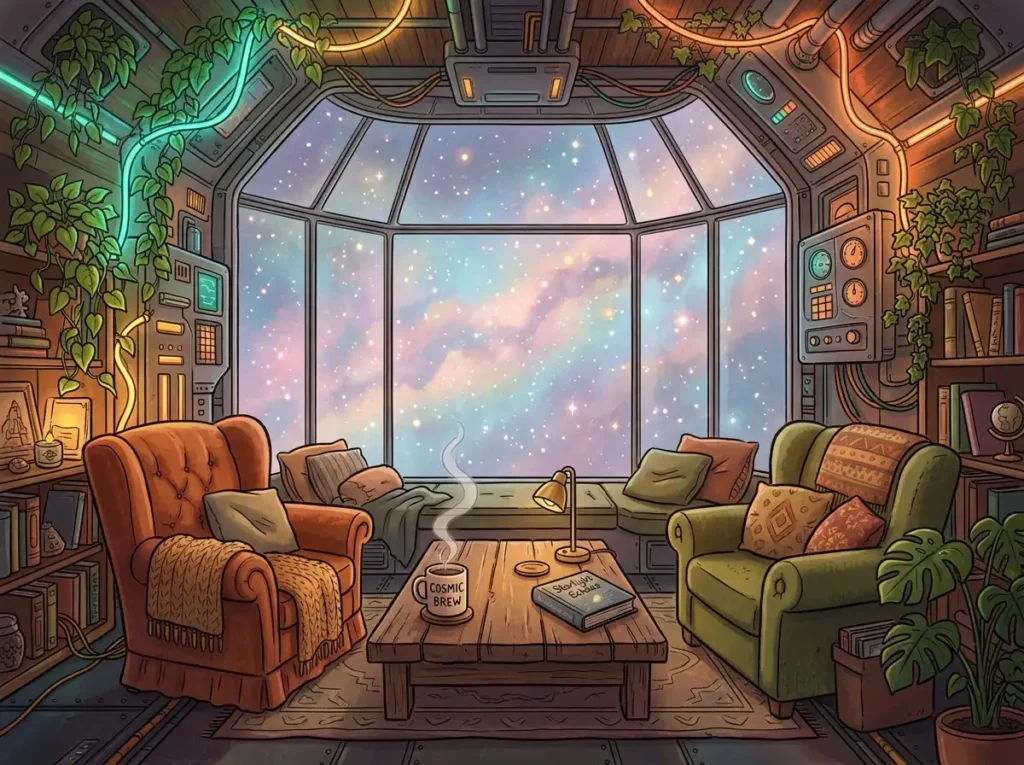
For the past few years, the fantasy landscape has been thoroughly dominated by a single, undisputed aesthetic: cozy comfort. Following the breakout success of Travis Baldree’s Legends & Lattes, readers fled high-stakes battles, grimdark betrayals, and complex political intrigue in droves. They chose instead to settle down with lower stakes, predictable arcs, and heartwarming tales of witches running bakeries, goblins opening coffee shops, and tight-knit communities fixing up magical bookstores. It was a beautiful, comforting subgenre boom that proved readers were collectively experiencing plot-fatigue, seeking safe literary havens from an increasingly stressful real world.
The Deconstructive Shift: Moving Away from Bleak Futures
 To truly appreciate why this transition is so revolutionary, one must look at what science fiction has traditionally represented for the average reader. For decades, sci-fi has been deeply rooted in the cautionary tale. From classic cyberpunk futures to sprawling space operas, the genre has leaned heavily on high-concept anxiety: rogue artificial intelligences, oppressive corporate oligarchies, terrifying alien invasions, resource wars, and bleak, post-apocalyptic survival scenarios.
While those narratives are crucial mirrors for societal fears, they offer very little in the way of emotional respite. The rise of cozy sci-fi acts as a direct deconstruction of those tropes. Instead of asking how technology will destroy our humanity, these comforting narratives ask how humanity—and the alien life we encounter—will maintain connection, kindness, and empathy across the vast, cold expanses of the universe. The stakes drop from preventing galactic annihilation to simply trying to build a functional home, repair a damaged starship engine with friends, or establish a meaningful cross-species dialogue over a warm meal on a far-flung research vessel.
The Pillars of Cosmic Comfort: What Defines the Genre?
Cozy science fiction is not just standard sci-fi with the action removed. It is a highly deliberate aesthetic framework that relies on several distinct narrative pillars to achieve its signature warmth:
- Found Families in Deep Space: At the heart of nearly every cozy sci-fi novel is a fiercely loyal, beautifully diverse crew. These characters are often ordinary working-class individuals—space-tinkers, minor researchers, interstellar couriers—who have built a functional family unit out of shared proximity and mutual respect. The joy of the book comes from watching them bicker over chores, share meals, and support one another through quiet personal struggles.
- Hopeful Technology (Solarpunk Aesthetics): Rather than portraying technology as a cold, oppressive force that detaches us from nature, cozy sci-fi often leans into solarpunk or biopunk elements. Technology is treated as a beautiful tool for sustainability, harmony, and community connection. Spaceships are depicted not as cold steel corridors, but as lived-in environments complete with thriving hydroponic gardens, soft fabrics, and warm, localized aesthetics.
- Low-Conflict, High-Connection Encounters: Traditional first-contact stories usually result in interplanetary warfare. In the cozy subgenre, meeting a new alien species is an opportunity for curiosity, cultural exchange, and humorous misunderstandings. The focus remains steadfast on finding common ground through shared emotional experiences, art, or food.
The Pathfinders: Authors Leading the Cosmic Comfort Charge
While the subgenre has exploded in recent months, several pioneering authors laid the vital groundwork for this transition, proving to publishers that readers were hungry for gentler stars.
Chief among these pathfinders is Becky Chambers, whose Wayfarers series (beginning with The Long Way to a Small, Angry Planet) serves as the absolute blueprint for cosmic comfort. Chambers shifted the space opera lens entirely away from emperors and soldiers to focus instead on a multi-species crew whose job is simply to punch wormholes through space. The narrative priority is placed on character growth, systemic kindness, and the small everyday interactions that make a starship feel like a home. Similarly, her Monk and Robot novellas showcase a beautifully gentle, solarpunk world where an ascetic tea monk and a wild robot ponder the nature of consciousness over bowls of hot soup.
This groundswell has been amplified exponentially by major cinematic and cross-media synergy. For instance, the enduring popularity of Andy Weir’s Project Hail Mary—which masterfully balances hard-science problem-solving with an incredibly moving, humorous, and heartwarming alien companionship—has driven millions of readers to seek out stories that prioritize cooperation over conflict. When the screen adaptation brings this dynamic to a massive global audience, it will solidify this craving for mutual survival over mutual destruction as a cornerstone of modern fiction.
Why Readers Crave Comfort Among the Stars
 The cultural obsession with cozy media is not an accidental fad; it is a direct coping mechanism. In a world hyper-saturated with real-time global crises, ecological anxieties, and economic uncertainty, our brains are experiencing chronic narrative fatigue. When every headline reads like the opening chapter of a dystopian novel, returning home to a book that promises more of the same bleakness can feel less like entertainment and more like an emotional chore.
The rise of cozy sci-fi offers a uniquely profound brand of escapism. Fantasy provides comfort by looking backward to a romanticized, pastoral past that never truly existed. Sci-fi, however, provides comfort by looking *forward*. It validates our desire for survival, suggesting that despite our current flaws, short-sightedness, and systemic problems, humanity actually makes it to the stars. It promises that the future is not something to be feared, but a vast, beautiful canvas where we will continue to love, create art, drink tea, and find community among the nebulae.
Conclusion: The Endless Horizon of Gentle Exploration
Ultimately, the massive success of cozy science fiction proves that a story does not require a galactic war or a dying planet to be completely unputdownable. Sometimes, the most compelling journey is a quiet one. By showing us that the cold depths of the universe can be filled with warmth, light, and empathy, authors are charting an exciting new course for speculative fiction.
As the subgenre continues to scale across BookTok and traditional shelves, it invites readers to shed their armor, step aboard, and realize that no matter how vast the universe gets, there will always be room for a comfortable chair, a hot drink, and a welcoming crew. The bakery doors may be closing, but the airlocks are open, and the stars have never looked friendaver or more inviting.